What a Single FSH Test Can and Cannot Tell You
A single FSH test cannot diagnose perimenopause, despite what most clinics treat it as.

A single FSH reading, taken during perimenopause, cannot diagnose the transition, rule it out, or tell a patient where she stands in it. Most clinics still order it as if it can, and most patients still walk out with a number that gets treated as a verdict. This piece walks through what the test can actually do, why it fails so often when used alone, and what a fuller assessment looks like instead.
The Legitimate Uses and Ceiling of a Single FSH Reading
A high FSH result means something real is happening. It reflects a pituitary gland working harder than it used to, pumping out more follicle-stimulating hormone because the ovaries are responding less predictably to the usual signal. That's a genuine marker of the hypothalamic-pituitary-ovarian feedback loop shifting, and nobody disputes that part.
The threshold that gets thrown around, an FSH above 25 to 30 IU/L pointing to menopausal changes, only holds up when the elevation is persistent, though. One draw showing a number in that range establishes nothing more than the fact that on one particular day, at one particular hour, the pituitary was working overtime. The diagnostic bar for ovarian insufficiency spells this out directly: FSH above 40 µIU/mL, confirmed on two separate assays more than a month apart. A single value, however high, never clears that bar alone, and treating it as if it does is the most common misuse of this test.
The reverse gets less attention but matters just as much. A low or "normal" FSH result on the day of a blood draw does not mean perimenopause isn't underway. Ovaries in transition still produce estrogen, sometimes in bursts higher than a woman saw in her 20s or 30s, and that estrogen suppresses FSH right back toward a premenopausal-looking number. A clean result can just mean the sample caught a lucky follicle, not that the transition hasn't started.
Two situations exist where a single FSH test does carry real weight. In established postmenopause, where the ovaries have no responsive follicles left and FSH has settled into a stable elevated plateau, one sample is enough. And in suspected premature ovarian insufficiency under age 40, where missing the diagnosis carries real stakes for fertility planning and bone health, a single elevated result is worth acting on quickly, even ahead of formal confirmation.
Timing complicates things further. FSH reads most clearly when drawn during the early follicular phase, specifically days 2 through 5 of a cycle. That instruction assumes a woman has a cycle regular enough to count days from, and perimenopause, by definition, disrupts that regularity, so hitting the "right" window turns into guesswork for a lot of patients. Medications compound the issue: combined hormonal contraceptives and hormone therapy invalidate FSH readings outright, and depot medroxyprogesterone acetate can suppress FSH low enough that a result under 30 IU/L during DMPA use tells a clinician nothing about whether perimenopause has begun.
FSH Fluctuation During Perimenopause and the Measurement Reliability Problem
The instability isn't anecdotal. It appears in the data with a clarity that should reshape how clinicians think about ordering the test at all, and once you see the number behind it, the case for routine single-draw testing mostly falls apart.
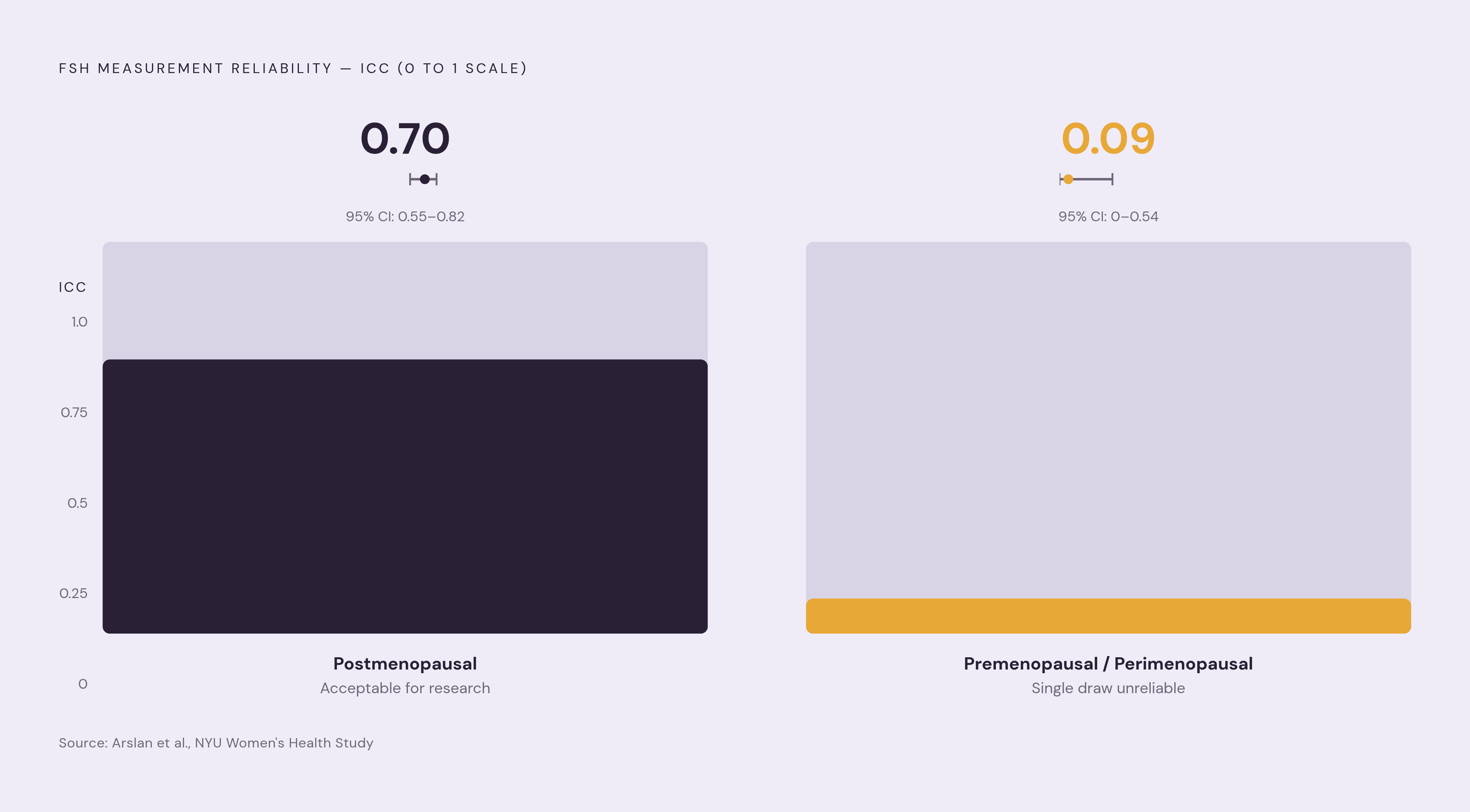
A study published in Reproductive Biology and Endocrinology by Arslan and colleagues, drawing on the NYU Women's Health Study, calculated the intraclass correlation coefficient, a statistical measure of how consistent a single measurement is when repeated, for FSH in two populations. For postmenopausal women, the ICC came out to 0.70 (95% CI: 0.55 to 0.82), a level generally considered acceptable for research use. For premenopausal women, meaning women still cycling, including those in perimenopause, the ICC dropped to 0.09 (95% CI: 0 to 0.54).
What does an ICC of 0.09 actually mean in practice? A single FSH value in a cycling woman bears almost no predictable relationship to another value drawn from the same woman a year later. The reading might as well be a coin flip dressed up as a lab result, and any clinical decision built on that one number is standing on the same ground.
Why does the swing get that extreme? FSH doesn't just report on follicle activity, it drives it. As the number of available, responsive follicles varies from cycle to cycle, sometimes even week to week in the perimenopausal ovary, FSH rises and falls in direct response. Greater variability in the follicle pool produces greater variability in the hormone reading. This is a feedback system reacting to a moving target, not measuring a fixed one.
That has a specific clinical consequence: a woman can get an elevated FSH result one month and a normal one three months later, and neither result means what it appears to mean in isolation. The second reading doesn't signal that perimenopause reversed. It usually means a follicle happened to respond that cycle, estrogen rose, and FSH got suppressed back down. Treating either single result as diagnostic creates two failure modes on opposite ends: false reassurance, where a normal reading gets used to dismiss a symptomatic woman, and unnecessary alarm, where an elevated reading gets treated as confirmation when nothing has actually changed yet. Of the two, false reassurance does more damage, because it closes off further workup exactly when a patient needs someone paying attention.
Guideline Handling and Disagreement on FSH Testing in Practice
Major guideline bodies have converged on a position that surprises a lot of patients: skip the test, for most women in the relevant age range.
NICE guideline NG23, updated in 2024, states that lab tests should not be used to diagnose perimenopause in people aged 45 and over. Diagnosis rests on age, symptom pattern, and menstrual history instead. NICE carves out exceptions for symptomatic women aged 40 to 45, where FSH testing can be considered, and for women under 40 where premature ovarian insufficiency is a concern.
ACOG takes a similar line, treating perimenopause as a clinical diagnosis built from age, symptoms, and cycle changes rather than routine hormone panels. Some guidance goes further, noting that FSH measurement to diagnose perimenopause or menopause is not usually indicated, because a single measurement is not a reliable indicator given how much hormone levels fluctuate day to day. A 2025 European Society of Endocrinology clinical guideline lands on the same conclusion: biochemical testing for diagnosis or management of perimenopause or menopause in women over 45 is not necessary.
Where the guidelines do agree on testing, they agree on repetition. For diagnosing menopause before age 40, the recommendation calls for two separate FSH samples, drawn 4 to 6 weeks apart. Written into clinical guidance itself, that requirement is an admission that one value cannot carry the diagnostic weight alone.
And yet a single FSH test still gets ordered constantly, and a normal result still gets used, in practice, to close the conversation with a symptomatic woman in her late 40s. That gap, between what the guidelines say and what happens in an exam room, is the gap this piece keeps circling back to. Adding estradiol to the panel helps some, since low estradiol paired with high FSH tells a more complete story than either number alone. But estradiol swings just as unpredictably as FSH during this phase, so a single estradiol snapshot inherits the same limitations.
Symptom Onset Before, and Despite, Abnormal FSH Numbers
Somewhere between 80 and 90 percent of women experience perimenopausal symptoms, and the range extends well past hot flashes. Mood disruption, cognitive fog, urogenital changes, sleep disturbance, joint and muscle aches: all of it falls under the same umbrella, and much of it occurs before any hormone panel would flag an obvious problem.
A study published in the journal Menopause gave a name to a pattern clinicians have long noticed anecdotally: "Not Feeling Like Myself." The paper described how the earliest perimenopausal symptoms tend to be neurological and psychological rather than vasomotor: fatigue, brain fog, a sharper edge to anxiety, a sense of emotional disconnection, arriving well before the night sweats and hot flashes most people associate with the transition.
Take a woman in her late 40s with hot flushes, disrupted sleep, and periods that have gone from clockwork to unpredictable. By any reasonable clinical read, she's in perimenopause. If her FSH and estradiol happen to look normal on the day of the blood draw, that lab result doesn't change what her body is actually doing, and per the guidelines above, it isn't supposed to change the clinical read either. In practice, though, a normal number on a lab report carries a kind of authority that a patient's own description of her symptoms often doesn't get, and that's backwards given what the ICC data says about how little that number actually proves.
The unpredictability cuts both ways. Six weeks of disruptive night sweats, followed by two months where everything feels normal again, followed by a heavy period, followed by a skipped cycle entirely: that erratic pattern is the signature of the phase itself. It's the signature of the phase itself, mirroring the same hormonal volatility that makes FSH so hard to pin down in a single draw. Because both symptoms and hormones swing unpredictably rather than declining in a straight line, women get caught at multiple points where a normal test result and a rough patch of symptoms don't line up. Too often, it's the number that wins the argument, not the lived experience, and that's exactly the wrong default.
STRAW+10 Staging Versus a Hormone Number Alone
If a single FSH value can't answer where a woman stands in the transition, what can? The STRAW+10 framework, first established in 2001 and updated in 2011 by scientists from multiple countries and disciplines, was built specifically to answer that question, and it does so by refusing to lean on any single marker.
STRAW+10 stages reproductive aging using three categories of evidence together: menstrual cycle characteristics, a cluster of hormone levels including FSH, AMH, inhibin B, and estradiol, and antral follicle count. The primary staging criterion is menstrual pattern, not hormones, and that ordering matters. The framework treats bleeding pattern as the low-cost, noninvasive signal that does most of the work, with hormone levels serving a secondary, supportive role.
The stage-by-stage picture shows how a raw number without context can misrepresent where a woman actually is in the reproductive-aging process. In Stage -3a, the late reproductive stage, AMH, inhibin B, and antral follicle counts have already begun to decline even as cycles may still appear regular. Stage -2, the early menopausal transition, involves increasing cycle irregularity, AMH that's very low or undetectable, and rising FSH. Stage -1, the late transition, is defined by stretches of 60 or more days without a period, FSH consistently above 25 mIU/mL, and the point where vasomotor symptoms often intensify. By Stage +1a, early postmenopause, FSH keeps climbing, estradiol sits low, and hot flashes often peak.
That staging structure clarifies that an elevated FSH reading that looks alarming out of context might simply mark Stage -3a, the very beginning of a transition that could run for years before actual menopause arrives. A normal FSH in a woman with irregular cycles and clear symptoms doesn't place her outside the framework either, since menstrual pattern, not the hormone number, does the primary classification work. Perimenopause typically starts sometime in the 40s, though it can begin as early as the mid-30s, and the average length runs around four years, with a documented range of two to ten years. That span alone explains why a snapshot value matters so much less than tracking where someone falls along the arc.
The case for serial testing: what changes over time that one draw cannot show
One result is a photograph. A series of results, spaced out over months, is closer to a film, and film is what a process defined by volatility actually requires to be read correctly.
Serial FSH testing reveals things a single draw structurally cannot. It shows whether FSH trends upward across several draws, even if any individual value bounces around. It distinguishes a one-off elevated reading from a consistent, repeating pattern. And it lets a clinician line that trajectory up against changes in symptoms, cycle length, and menstrual pattern happening over the same stretch of time. The real diagnostic signal tends to live there.
Adding serial estradiol into the mix sharpens the picture further. Estradiol swinging high while FSH stays elevated at the same time tells a different clinical story than either value read alone, and it maps onto the estrogen "roller coaster" that characterizes early perimenopause rather than the flatter, low-estradiol picture of postmenopause.
AMH deserves a mention here too, since it behaves differently than FSH across the transition. AMH reflects ovarian reserve, the size of the remaining follicle pool, and it declines more steadily and predictably than FSH, without the same degree of cycle-phase dependence. That makes it a useful companion marker for tracking the overall trajectory of ovarian aging, even during stretches when FSH itself bounces around unpredictably.
None of this data means anything without a clinician actually reading it in context, though. Numbers tracked over months still need interpretation alongside symptoms, medication changes, and personal history, because data without that context amounts to little more than a spreadsheet. The POI diagnostic standard makes the underlying principle explicit: FSH above 40 µIU/mL, confirmed on two assays more than a month apart. That requirement for two separated draws reflects the exact mechanism that separates a genuine finding from a fluctuation that would have resolved on its own. It's the exact mechanism that separates a genuine finding from a fluctuation that would have resolved on its own.
What a useful perimenopause assessment includes beyond FSH
Clinical history does most of the heavy lifting before anyone reaches for a lab order. Age, the specific way a menstrual cycle has changed (length, flow, missed periods), when symptoms started and what they feel like, current medications, contraceptive use, and relevant personal and family history: that's the foundation everything else sits on top of.
From there, a handful of hormone markers add more than FSH manages alone. Estradiol gives context, since a low reading alongside high FSH tells a fuller story than either number in isolation, though it carries the same single-draw limitation FSH does. AMH offers a steadier read on ovarian reserve, less tied to where a woman happens to be in her cycle on the day of the draw, which makes it genuinely useful for tracking depletion of the follicle pool over time. Progesterone can answer specific questions about ovulation, but only when timed deliberately; a random progesterone value pulled from an irregular cycle carries almost no interpretive weight on its own.
Some tests belong in the workup not to confirm perimenopause but to rule out the conditions that mimic it. Thyroid disease shares an enormous amount of symptom overlap with perimenopause: fatigue, mood shifts, weight changes, cycle disruption. Iron and ferritin levels matter especially when bleeding has become heavy or irregular, since anemia stacks directly on top of the fatigue and brain fog perimenopause already causes. B12 deficiency should be checked when diet, certain medications like metformin or acid reducers, or neurological symptoms make it plausible.
Cardiometabolic markers round out a thorough assessment, even though they aren't specific to perimenopause at all. Blood pressure, lipid panels, and blood glucose matter because this stage of life coincides with real shifts in cardiovascular risk, and it's a natural point at which to be checking anyway.
A test earns its place in the workup by having the power to change a clinical decision, not by producing a number that stands in for a conversation. Women engaging with their own longitudinal data, tracked over months rather than glimpsed once, are fully capable of understanding what a trend means when someone explains it clearly. The goal was never just a result. It's an interpretation a patient can actually act on.
Using an FSH Result in a Clinical Conversation
An FSH number, on its own, resolves nothing. Used well, it opens a conversation instead of closing one, and that distinction runs through everything above it.
A single elevated reading is a prompt to ask what else is going on. Has the menstrual pattern shifted toward the 60-day amenorrhea threshold that STRAW+10 uses to mark the late transition? Have symptoms shown the erratic, on-again-off-again pattern that mirrors hormonal volatility rather than steady decline? Would a second draw, spaced weeks out, show the same elevation or a very different number entirely? Each of those questions does more diagnostic work than the original result did by itself.
A normal reading deserves the same scrutiny rather than automatic reassurance. If a woman is describing night sweats, cycle changes, and a cognitive fog that wasn't there two years ago, a single normal FSH shouldn't override that history, not once you account for how unreliable that single number actually is. It's one data point in a system where, per the Arslan study, a single premenopausal FSH reading has an ICC of just 0.09. That's not a number that can support dismissing a patient, and any clinician who uses it that way is misreading what the test can bear.
The clinicians and patients who get the most out of FSH testing treat it as one input feeding a broader picture: menstrual history, symptom trajectory, other lab markers like AMH and thyroid function, and, where the stakes call for it, a second draw down the line. That's a more demanding way to practice medicine than reading a single number off a lab report. It also happens to be the only version that actually matches the biology, which was never going to sit still long enough for one blood draw to capture it.