Heart Rate Variability Tracking Limitations for Hormonal Health
Wearables detect nervous system strain during perimenopause but cannot identify its hormonal source.
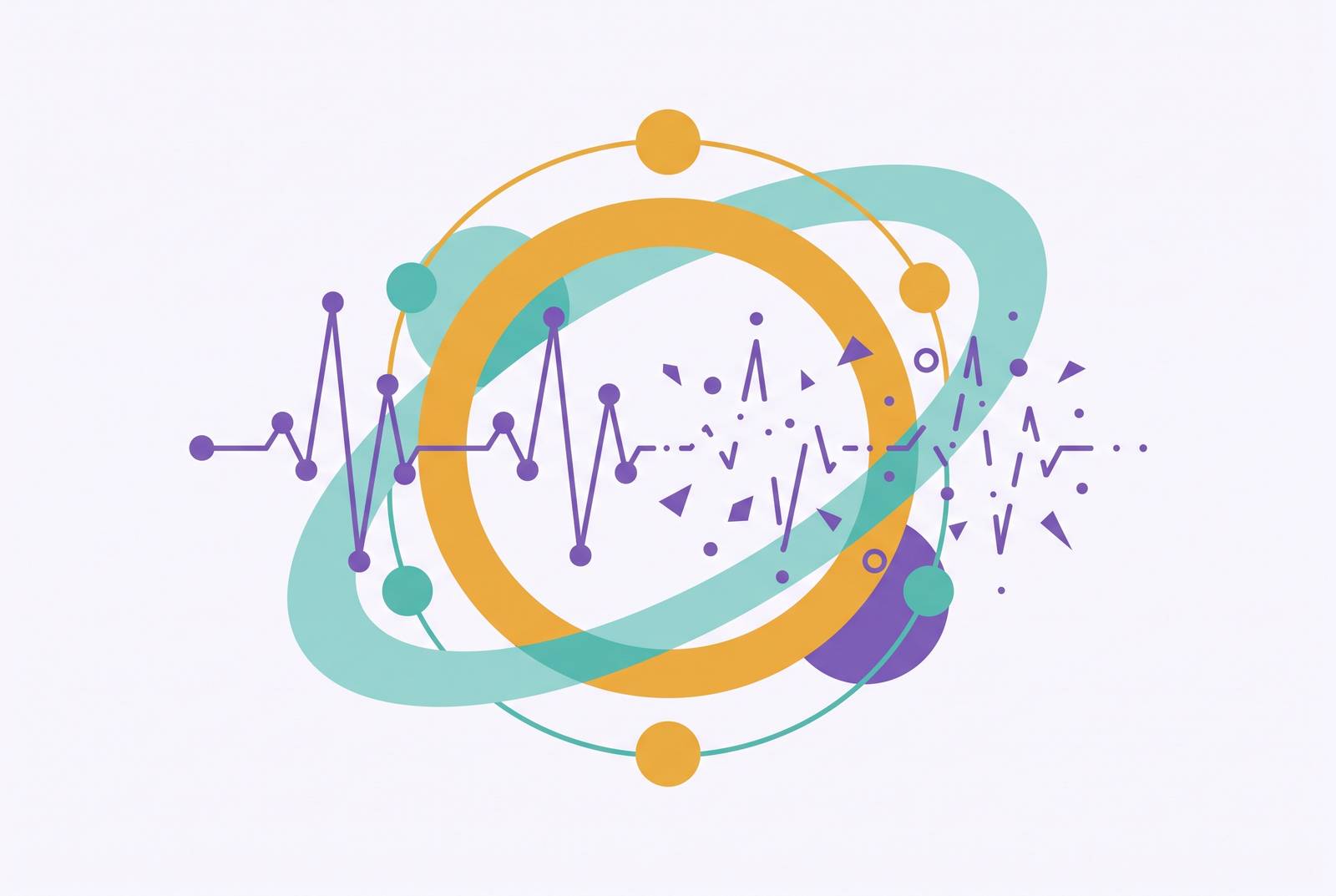
Heart rate variability tracking can tell a woman that her nervous system is under strain during perimenopause, but it cannot tell her why. That gap between detecting strain and explaining its source is the subject of this piece: what HRV actually measures, why perimenopause disrupts it through several biological routes at once, and what kind of testing is needed to find the hormonal picture a wearable cannot see.
What HRV Measures
Heart rate variability quantifies the beat-to-beat variation in time between heartbeats, a signal driven by the ongoing push and pull between the sympathetic nervous system, responsible for fight-or-flight activation, and the parasympathetic nervous system, responsible for rest and recovery. A higher variability score generally reflects a nervous system that can shift flexibly between these two states, while a lower score suggests a system under sustained strain, though the device reporting that score has no way of naming what the strain is. That accessibility is also the source of its central limitation. A wearable can report that the autonomic nervous system is leaning toward stress dominance on a given morning, but it has no channel through which to report what pushed it there. The number is an effect, read off the body in real time, and the cause sits upstream of anything the sensor can access. That distance between what the device reads and what produced the reading is the interpretive gap this piece is built around, and it becomes especially consequential once hormonal fluctuation enters the picture.
Why perimenopause specifically suppresses HRV through multiple simultaneous pathways
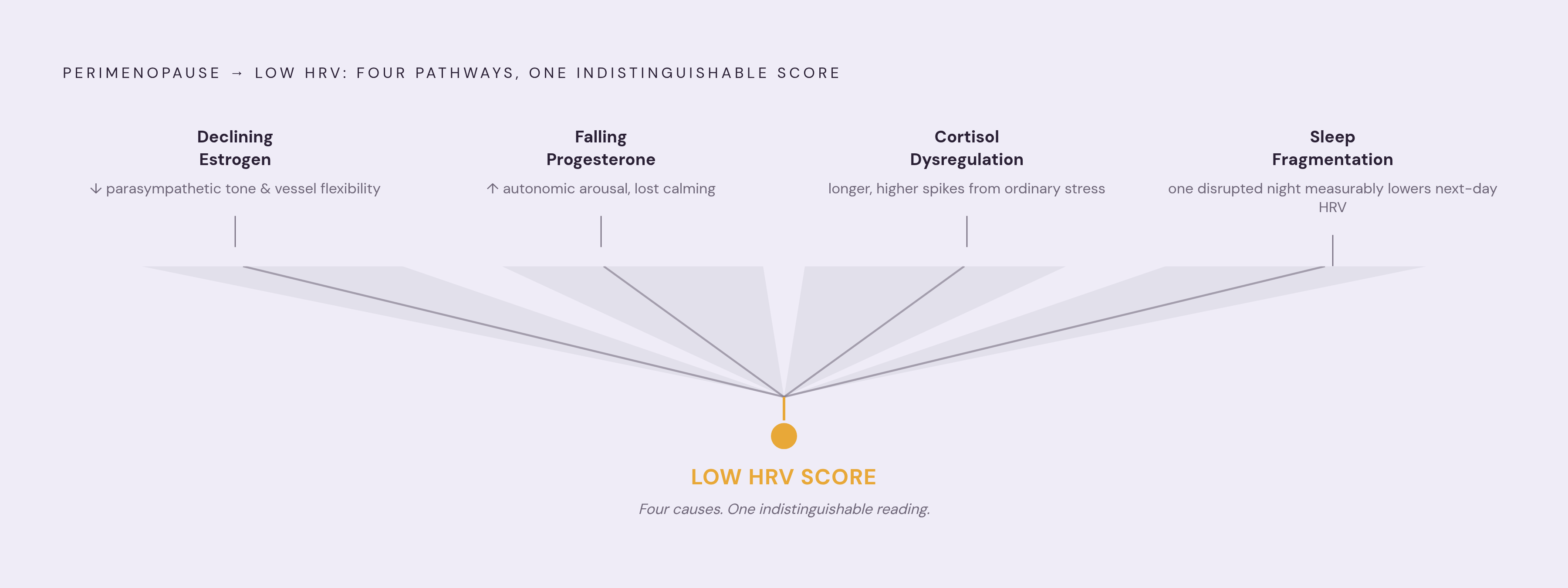
Perimenopause lowers HRV through several hormonal mechanisms at once, not a single clean one. It does so through several pathways operating at the same time, which is what makes a low score during this transition genuinely meaningful and genuinely hard to decode. Declining estrogen reduces parasympathetic tone and the flexibility of blood vessels, and lower estrogen is directly linked to reduced HRV. Progesterone contributes a separate effect: its naturally calming, anti-anxiety influence on the nervous system fades as its levels drop early in the transition, and that withdrawal raises autonomic arousal independent of whatever estrogen is doing. The hormonal shifts compound a third pathway by impairing cortisol regulation, so stressors a woman once absorbed without much strain now produce cortisol elevations that run longer and higher than they used to. A fourth pathway runs through sleep: night sweats and hot flashes fragment rest, and even one disrupted night measurably lowers next-day HRV, with chronic disruption keeping the score suppressed for weeks at a stretch.
The most counterintuitive piece of this picture is what might be called the hormonal paradox of early perimenopause. The transition is often assumed to be a story of declining estrogen, but early perimenopause frequently involves estrogen that is elevated and erratic rather than simply low. Both states, the high erratic phase and the later low phase, suppress HRV, but they do so through different mechanisms entirely. That means a woman looking at a low HRV score has no way of knowing, from the number alone, whether her estrogen is spiking unpredictably or declining steadily. The same depressed reading can describe opposite hormonal realities depending on where she sits in the transition. Research adds a layer of texture here rather than resolving it: a 2026 systematic review by Hira and colleagues found that perimenopausal women with vasomotor symptoms had lower resting LF and HF power, indicating reduced cardiac parasympathetic and sympathetic function, compared to women without those symptoms. A separate living systematic review published in Sports Medicine in 2026 found that HRV tends to decline after menopause as age increases, which raises a question the field has not settled: whether it is reproductive stage or aging itself doing most of the work. Why does that distinction matter so much? Because if age is driving a meaningful share of the decline, then HRV becomes even less specific to the hormonal transition than it already appears.
Why the device cannot identify the responsible pathway
HRV is affected by perimenopause. The device still cannot identify which pathway is responsible, and that gap between detection and attribution is the central claim of this piece. Alcohol, poor sleep, psychological stress, training load, and hormonal flux all suppress HRV through the same autonomic channel, so a low score cannot be pinned on any single cause, hormones included. These confounders do not take turns. They co-occur constantly in midlife women, layering a stressful week, a few glasses of wine, a poor night's sleep, and a hormonal swing on top of each other, and de Jager and colleagues found in 2026 that few studies even attempt to explicitly account for them. The device's algorithm has no mechanism to separate hormonal autonomic suppression from stress-state suppression because the output looks identical either way. Ubie Health's 2026 review notes that the device reports "high stress" even when the underlying cause is hormonal.
That misattribution carries a real practical cost. A woman who trusts the readout as a stress signal may reasonably escalate behavioral interventions: more meditation, reduced exercise, cutting out alcohol entirely, all while the actual driver, hormonal flux, continues unaddressed. She is doing the work the device implied she should do, and the number may not move, because the number was never primarily about her behavior. Layered on top of this is the question of whether HRV even tracks reproductive stage cleanly. A 2025 cross-sectional study out of Gujarat found that HRV parameters showed no uniform trend of decline moving from premenopause through perimenopause into postmenopause, suggesting that age itself, rather than reproductive stage, may be driving more of the change than the transition does. The wearables compound the problem at the hardware level. Banerjee's 2026 analysis notes that motion artifacts corrupt PPG-based ambulatory monitoring, and most consumer devices hand back a single daily composite score with no access to the underlying R-R interval data that might let a more sophisticated read distinguish one cause from another. Even the scientific literature trying to make sense of all this is hampered by inconsistency: different device types, different measurement durations, different timing protocols, and different HRV metrics make comparison across studies difficult, a problem Hira and colleagues flag directly in their 2026 review.
What the research on HRV and vasomotor symptoms found
The most rigorous available review of HRV and menopausal vasomotor symptoms found a directional association, not a confirmed one, because the evidence base supporting it is thin and inconsistently built. In the Hira et al. 2026 systematic review, two of the three eligible studies found differences in LF and LF/HF ratios between women with and without vasomotor symptoms, but when the data were pooled, the result fell just outside the threshold for statistical significance. The authors themselves identified the reason: only three studies met inclusion criteria for pooled analysis, a base too small to support clinical conclusions. This is an honest statement of where the science currently stands, not a failure of the researchers, and one might argue that honesty is more useful to a woman trying to interpret her own numbers than a confident claim the data cannot yet support.
The Sports Medicine living systematic review from 2026 ran into a related obstacle. Variability in how studies classified menstrual cycle phase and menopausal status limited how comparable the findings were and limited how much could be synthesized quantitatively across them. Without that confirmed hormonal context, the HRV readings collected in these studies cannot be reliably tied to specific hormonal states in the first place. That gap in evidence is itself a clinical reality: if researchers with access to controlled conditions and validated instruments cannot yet establish the HRV-hormone link definitively, a consumer wearable certainly cannot make that attribution in real time.
Symptom Overlap with Other Conditions
Distinguishing hormones from stress is only one layer of the attribution challenge. Perimenopause shares its symptom profile, and its effect on HRV, with thyroid dysfunction, anxiety disorders, and sleep disorders, so a low score cannot even confirm that hormones are the relevant factor at all, and Hashimoto's thyroiditis in particular is frequently confused with perimenopause because both produce fatigue, brain fog, weight gain, and mood swings while also disrupting the autonomic regulation that HRV reflects. Fatigue, sleep disturbance, palpitations, heat intolerance, weight fluctuation, brain fog, mood changes, and cognitive difficulty appear across perimenopause, thyroid disease, psychiatric conditions, medication side effects, chronic stress, and primary sleep disorders, often in some combination rather than in isolation. Depressive and anxiety disorders present a similar overlap, sharing sleep disruption, fatigue, diminished concentration, and irritability with the perimenopausal symptom cluster, so the same set of complaints can get attributed to menopause, depression, stress, or a somatic disorder depending on who is doing the attributing.
This overlap produces real diagnostic consequences, not just theoretical ambiguity. A national survey found that nearly two-fifths of women said they were misdiagnosed during perimenopause, and fewer than half had a primary care provider who initiated the conversation about perimenopause symptoms in the first place. Age bias compounds the structural gap: women in their 30s and early 40s are frequently told they are too young for perimenopause, which pushes their symptoms toward a psychiatric or stress-related diagnosis by default. A low HRV reading entering that kind of clinical encounter does not help. It can reinforce the wrong interpretation, appearing to confirm "stress" to a clinician who was not considering hormonal causes to begin with, unless the woman brings more specific data into the room. That is the practical stake of everything the earlier sections establish: a low score, read in isolation, is as likely to send a woman down the wrong diagnostic path as the right one.
Why hormone testing addresses what HRV cannot
Hormone testing can identify the specific hormonal picture producing a low HRV score, but only if it measures the right markers, at the right time, more than once. There is no single blood test that confirms perimenopause on its own, and hormone levels can fall within normal reference ranges during perimenopause even while a woman is experiencing clear symptoms, so a single normal result does not settle anything. Estradiol measured alone tells an incomplete story. It needs FSH, LH, and cycle-timed progesterone alongside it, since each marker illuminates a different part of the hormonal picture rather than standing in for the whole thing. Progesterone in particular has to be timed to the luteal phase, roughly days 19 through 21 of the cycle, or the result misleads: tested at the wrong point in the cycle, progesterone can look adequate when it is functionally insufficient.
Hormonal contraceptives introduce their own confounder. FSH results are unreliable for women taking combined oral contraceptives or high-dose progestogens, and a woman using a hormonal IUD may get back a falsely normal FSH reading that shuts down the clinical conversation before it has really started. Clinical guidance reflects how seriously this timing and context problem is taken. NICE guideline NG23, updated in 2024, advises against using lab tests to diagnose perimenopause in women 45 and older based on age and symptoms alone, while recommending that FSH be considered for women between 40 and 45 who are symptomatic. The European Society of Human Reproduction and Embryology recommends two tests taken four to six weeks apart before any conclusion is drawn. Neither guideline treats a single number as sufficient. Because hormone levels genuinely fluctuate week to week during this transition, a pattern built from multiple tests over time reveals something a single result cannot: a persistent trend rather than one data point caught at an arbitrary moment. None of that pattern interprets itself. A panel of numbers without a clinician weighing them against a woman's symptoms and cycle history is not yet an answer, only raw material for one.
Using HRV productively without mistaking it for a hormonal answer
A persistently low HRV score is most useful treated as a prompt to look further, not as a diagnosis in itself, and the investigation it should prompt is a hormonal one, not only a behavioral one. HRV's real strength is longitudinal. A single morning's reading says little, but a personal trend tracked across months, especially when paired with a cycle diary and a symptom log, can reveal something meaningful that no isolated snapshot could show. The 2026 Sports Medicine living systematic review found that wearable-derived HRV does fluctuate across the menstrual cycle, with time-domain HRV differences ranging from 3 to 9 percent depending on cycle phase, and with the strength of association to premenstrual disorder symptoms varying from one individual to the next. That variability between individuals is itself informative: it suggests that tracking a woman's own pattern over time carries more diagnostic weight than comparing her single reading against a population average. One might ask what the stakes are for a woman who simply decides to ignore a chronically low score rather than chase down its cause. Ubie Health's 2026 review found that autonomic suppression in postmenopausal women has been associated with higher cardiovascular risk over the longer term, so a score that stays low for months is worth raising with a clinician regardless of what turns out to be causing it.
Some symptoms should prompt urgent medical attention on their own terms, independent of whatever the HRV trend line is doing: chest pain, severe heart palpitations, and fainting all fall into that category and warrant care without waiting for a wearable to confirm anything. Short of those red flags, the more realistic use of HRV is as a prompt rather than a verdict. A low or declining trend is a reasonable reason to bring a cycle log, a symptom history, and a specific request for multi-marker, cycle-timed hormone testing into a clinical conversation. The wearable can tell a woman that something in her physiology is under strain. Finding out what that something is still requires the kind of testing, and the kind of clinical interpretation, that no sensor on the wrist was ever built to provide.
Sources
- Understanding the shortcomings of heart rate variability as a tool for autonomic analysis
- A systematic review of heart rate variability and menopausal vasomotor symptoms - PMC
- Wearable-Derived Heart Rate Variability Across the Menstrual Cycle, Hormonal Contraceptive Use, and Reproductive Life Stages in Females: A Living Systematic Review
- Warning: Menopause Stress Is Tanking Your HRV Score—Act Now
- Age predominates as associate than reproductive health stage for 5 min heart rate variability in middle aged women- a cross-sectional study from Gujarat, India - PMC
- A systematic review of heart rate variability and menopausal vasomotor symptoms - Hira - 2026 - Physiological Reports - Wiley Online Library
- Wearable-Derived Heart Rate Variability Across the Menstrual Cycle, Hormonal Contraceptive Use, and Reproductive Life Stages in Females: A Living Systematic Review - PMC
- Is Heart Rate Variability Associated With Frequency and Bother of Vasomotor Symptoms Among Healthy Peri-Menopausal and Post-Menopausal Women? - PMC