When Wearable Data Should Prompt a Lab Draw
Wearables detect symptom patterns, but only blood work reveals their hormonal cause.
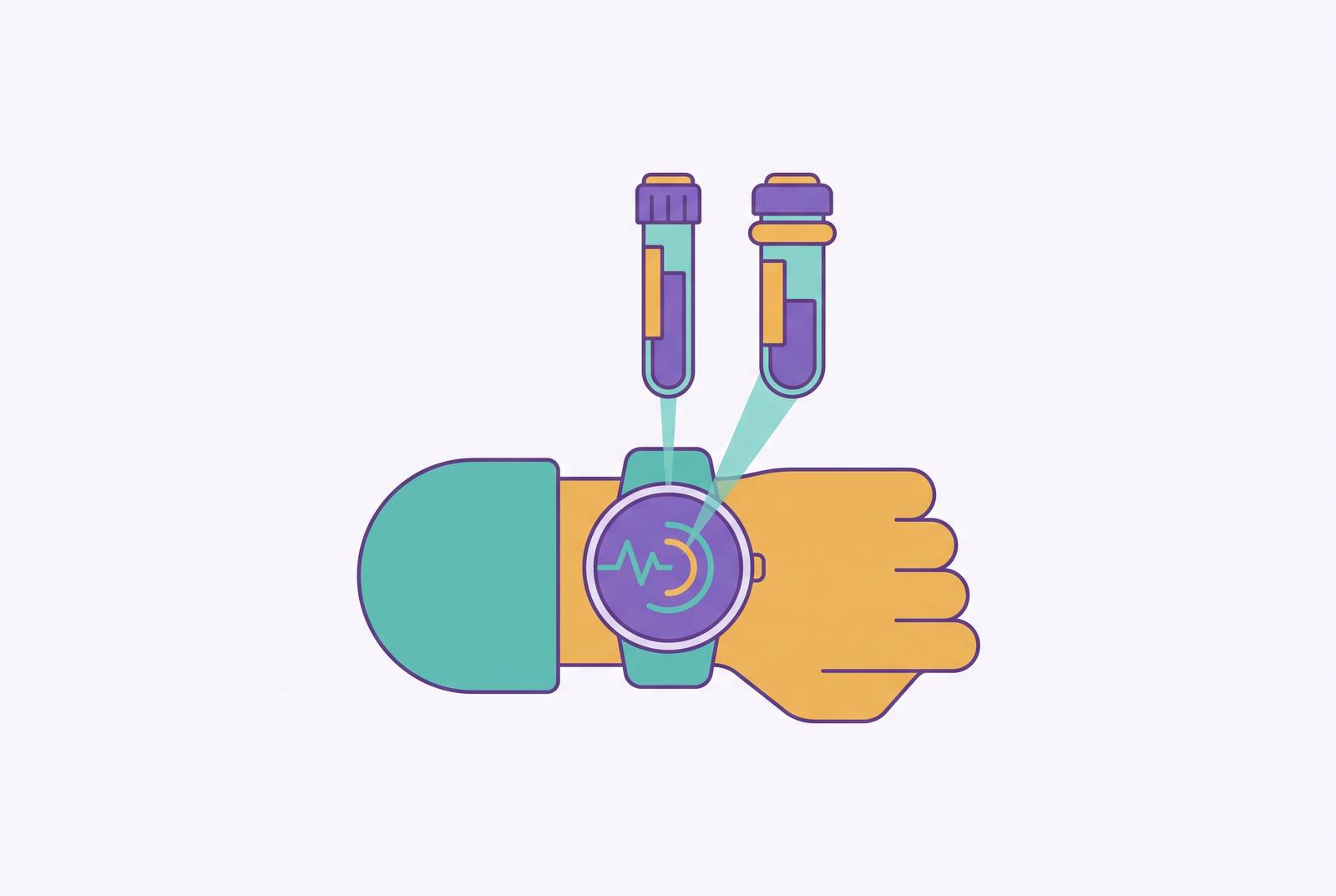
Wearables can tell a woman that her sleep is fragmenting, her resting heart rate is climbing, or her skin temperature is spiking at 3 a.m. What they cannot tell her is why. That gap, between a detected physiological shift and its hormonal cause, is where this piece lives: the specific moments when a wearable pattern should stop being a data point to monitor and start being a referral to a lab draw. When Wearable Data Should Prompt a Lab Draw.
Why wearables and hormone levels are measuring different things
Perimenopause is a transition without a start date. It is a transition that can begin as early as the mid-30s, with average onset somewhere between 45 and 47, and it can run anywhere from two years to a full decade before menopause itself arrives Allara Health BodySpec / Gold et al.. During that stretch, the body throws off a steady stream of measurable signals, including disrupted sleep, shifting skin temperature, an elevated resting heart rate, and the occasional vasomotor event that wakes someone up drenched. Wearables are built for exactly this kind of continuous output. Catching it, quantifying it, timestamping it, that is their genuine strength.
But catching a signal and explaining it are two different jobs Allara Health BodySpec / Gold et al.. A disrupted sleep graph does not say whether FSH is climbing, estrogen just spiked or crashed, the thyroid is misfiring, or something unrelated to hormones entirely is driving the pattern. At what point does a wearable pattern stop being informative on its own, and start functioning as a prompt for blood work? Neither tool, on its own, answers the whole question. The wearable shows that something changed. The lab draw explains what changed. Treating them as competitors misses the point; they are built to answer different halves of the same question.
What wearables can detect in a perimenopausal body
The category has gotten specific fast. Peri, from IdentifyHer, launched April 2, 2026 as a palm-sized device that adheres to the upper abdomen and tracks hot flashes, night sweats, anxiety, sleep patterns, menstrual cycles, and activity levels, priced at $449 with no subscription, and it picked up a CES Innovation Award Honoree distinction in 2025; the company describes it as generating the first large-scale dataset on perimenopause. Natural Cycles' NC° Band collects overnight biometric data and uses it to estimate perimenopause stage.
What ties these devices together affects how the resulting data can be used and interpreted, more than any single spec does. They convert something that used to live entirely in a patient's memory, an experience that was subjective, intermittent, and nearly impossible to document consistently, into an objective, time-stamped, longitudinal record. That is not a small thing. The "Our Transitions" clinical trial (NCT07597915) is built on exactly this premise: participants in its bring-your-own-device arm wear Oura rings, Garmin watches, Apple Watches, or Fitbits, while the main cohort standardizes on the Oura Ring Gen 4 and Fitbit Sense 2, and a sub-cohort of up to 75 participants layers in daily at-home urine hormone samples across three consecutive menstrual cycles. That is a real-world test of the exact pairing this article is arguing for: wearable data on one side, hormone data on the other, neither one asked to do the other's job.
The practical value is most visible at night. An estimated 75% of perimenopausal women experience symptoms disruptive enough to affect daily life, and a large share of those symptoms happen while asleep or otherwise away from any clinical setting. A provider never sees the 3 a.m. hot flash. A wearable does, and it logs it with a timestamp attached. Oura Ring tracks sleep and stress as standalone features and tracks temperature variation, cycle length, period length, and cycle phases via Cycle Insights, with a temperature accuracy of 0.13°C, and is backed by a reported $900M Series E in 2025. Delphea / Aurelia Vitals, an earring-back form factor founded by Dr. Alisha Menon, takes behind-ear temperature readings every 5 seconds, offers a 30-day charge, and tracks fertility windows and hormonal shifts via Bluetooth, with its behind-ear placement described as mirroring clinical thermometer placement.
Where wearable signals run out of explanatory power
Here is the limitation that matters most: no wearable on the market has an endocrine validation layer. None of them measure FSH, estradiol, progesterone, LH, AMH, or prolactin directly, and none of them read thyroid hormones either. That reflects a category boundary rather than a flaw in engineering. These are physiological sensors, not blood chemistry.
Why does that boundary matter so much in perimenopause specifically? Because estrogen during this transition does not decline in a straight line. It fluctuates, sometimes spiking well above typical levels before it crashes. A temperature spike or a night of fragmented sleep picked up by a wearable could reflect an estrogen surge, an estrogen crash, or a completely unrelated cause. The device has no way to distinguish between those three possibilities, and that is exactly the distinction that matters for treatment.
Research trying to validate wearable-estimated cycle phase or ovulation timing runs into a related problem: studies use inconsistent comparators, urinary LH in one, serum hormone panels in another, ultrasound or multi-hormone testing elsewhere, which makes it hard to compare accuracy claims across devices or across studies. More data streaming in does not automatically mean better clinical decisions get made from it. The value of any of this depends on the signals actually being modeled against real reproductive biology and meaningful endpoints, not just displayed on a dashboard.
One source states the asymmetry directly. A blood test only captures a single moment, and hormone levels shift throughout the day, so a lab draw has its own blind spot. But a wearable produces continuous data with zero hormonal context. Put those two limitations side by side and the shape of the solution becomes obvious Allara Health BodySpec / Gold et al.. A wearable can say something changed. It cannot say which hormonal mechanism changed, cannot say whether the change sits inside normal perimenopausal variation, and cannot say whether an entirely different condition is behind it.
The hormones a lab draw measures
FSH is erratic during perimenopause, fluctuating considerably week to week and even day to day, sometimes returning to premenopausal levels, so a single elevated result does not confirm menopause. One high FSH result is a data point, not a diagnosis.
Estradiol tells a different kind of story. The number on any single day matters less than the trajectory across several draws, which is why it is typically tested on cycle days 5, 12, and 21. The pattern of rise and fall carries the diagnostic weight, not any one snapshot. Progesterone, tested mid-luteal phase around day 21, gradually declines across perimenopause, and a low or absent luteal progesterone reading confirms an anovulatory cycle even in a woman who is still bleeding on a regular schedule. LH peaks alongside FSH at ovulation and rounds out the standard panel. AMH, produced inside ovarian follicles, declines as the follicle count drops, and it becomes especially useful for women whose cycle data is not available for tracking, someone with an IUD, for instance, or someone who has had a hysterectomy, and it can help flag premature ovarian insufficiency.
Timing governs whether any of this data means anything. Because cycles in perimenopause are already unpredictable, hitting a specific day-3 FSH draw is difficult, and results must be interpreted alongside symptom pattern and recent missed periods, not read in isolation. In that case, the result has to be read alongside the symptom pattern and any recent missed periods, not treated as a number that stands alone. And age changes the whole calculus: for women 45 and older, a clinical diagnosis often does not require lab confirmation at all, since elevated FSH is an expected finding at that stage of life Allara Health. For women under 45, lab confirmation becomes considerably more important clinically Allara Health. Cycle-day timing governs accuracy: FSH is best measured on days 2–5 of the cycle, with morning draws preferred as hormone levels are more concentrated then. Guidance recommends two FSH draws 4 to 6 weeks apart when testing to diagnose menopause before age 40, to rule out single-draw fluctuation.
Specific wearable patterns that should prompt a lab draw
A few patterns stand out as clear thresholds, moments where the wearable has done its job and the next move belongs to a lab.
A persistent, escalating vasomotor pattern is one. If a device shows week-over-week growth in temperature spikes or logged hot flashes that has not responded to any behavioral change, sleep hygiene, cooling strategies, whatever's been tried, that pattern calls for hormonal confirmation rather than more weeks of self-monitoring. Severe sleep disruption that keeps getting worse across several weeks is another. Fragmented, shortened sleep that is deteriorating rather than stabilizing is not self-explanatory; it could be perimenopausal, but it could also be sleep apnea or thyroid dysfunction, both of which produce overlapping symptoms and neither of which a wearable can distinguish on its own.
Age draws a hard line here. Any wearable-flagged pattern in a woman under 45 warrants lab confirmation, full stop, because elevated FSH in that age group cannot be assumed to be ordinary perimenopausal variation Allara Health. Premature ovarian insufficiency has to be ruled out, and that only happens with blood work Allara Health. Cycle irregularity that an app detects but cannot explain is a third trigger. The software can flag a shift from a regular cycle to an irregular one, but it has no way to determine whether that shift reflects early perimenopause, a thyroid disorder, PCOS, or something else entirely. An irregular cycle flagged by an app is a signal to test, not a diagnosis to accept at face value.
Then there is the mismatch case: a wearable logs a pattern, but the symptoms attached to it feel disproportionate or simply unusual. Joint pain shows up in roughly half of perimenopausal women, cognitive symptoms in something like 40% to 60% of women at midlife, and heart palpitations are in that same symptom cluster Geisinger. Every one of those symptoms also has other plausible explanations. When a wearable is logging the objective correlates of any of them, that is an argument for a hormonal workup, not a substitute for one Geisinger. And finally, watch for the plateau: if the wearable's data stabilizes while the woman's subjective experience keeps getting worse, the device has reached the edge of what it can explain. That gap between flat data and worsening symptoms is itself the signal to draw blood.
Why a single lab draw often isn't enough either
FSH, LH, estradiol, and progesterone all fluctuate naturally across perimenopause, which means one test only ever captures a snapshot. It may not reflect the hormonal pattern actually driving the symptoms a woman is living with day to day. A single elevated FSH result does not confirm that menopause has arrived or run its course, and that is not a reason to skip testing altogether, it is a reason to test more than once and watch how the numbers move over time.
This is precisely where wearable data and repeated lab draws stop competing and start working together. The wearable establishes the pattern and its trajectory over weeks. The lab draw, repeated at intervals, explains the hormonal mechanism that produces that trajectory, and repeated measurement over time is how that mechanism is identified. The "Our Transitions" trial makes this pairing explicit in its design: daily urine hormone samples across three consecutive cycles, collected alongside continuous wearable data, because each method answers a question the other cannot.
At-home testing has the same snapshot limitation. At-home FSH urine kits cannot definitively diagnose menopause and may run less accurate than a laboratory draw, and at-home saliva estradiol testing needs clinical interpretation to mean anything useful. When a wearable flags a pattern worth investigating, the goal is to begin a tracking relationship rather than settle for one confirmatory blood draw and a verdict. It is the start of a tracking relationship, built the same way the wearable data itself becomes more useful across four weeks than it ever is on day one.
How to use wearable data to have a more productive clinical conversation
Perimenopause remains chronically under-diagnosed, and symptoms get dismissed or misattributed often enough that many women arrive at appointments already braced for it. Showing up with weeks of objective, time-stamped wearable data changes the shape of that conversation before a word gets said about symptoms.
What is worth bringing is a documented pattern rather than an account of one bad night, including a temperature trend charted over four weeks, sleep fragmentation scores, a log of vasomotor events, and cycle length changes tracked across several cycles. Tell a provider that the wearable has been logging a specific pattern for a specific number of weeks, and that the goal is to understand what is driving it hormonally. That framing matters. The wearable data is the reason to test, not a substitute for the test itself.
Know where the age line sits. Under 45, a wearable-flagged pattern carries real weight as an argument for lab confirmation Allara Health BodySpec / Gold et al.. Over 45, a clinical diagnosis might come from symptoms alone, but lab data still adds value for figuring out treatment. If cycles are irregular, ask whether a day-3 FSH draw is realistically achievable, or whether the result will need to be read alongside symptom context instead. And given how well-documented the fluctuation problem is, one normal FSH result should not end the conversation.
Generic wellness advice is a thin substitute for something built on actual lab values. Wearable data, brought into the room and paired with a specific request for hormonal testing, is what turns a symptom description into an evidence base, and that is the entire argument this piece has been building toward, one tool telling a woman that something changed, the other telling her why. Ask for repeat testing, not just a single draw: given the known fluctuation in FSH levels, one normal reading does not rule out perimenopausal transition, so advocate for a second draw 4 to 6 weeks later if the first result seems inconsistent with the wearable-documented pattern.
Sources
- Perimenopause Timeline: How Early Can It Start and What To Expect
- When Does Perimenopause Start? | Geisinger
- Perimenopause Age: Signs, Timelines & What to Expect | BodySpec
- The diagnostic accuracy of wearable digital technology in detecting fertility window and menstrual cycles: a systematic review and Bayesian network meta-analysis
- How Oura Can Help You Manage Perimenopause - The Pulse Blog
- IdentifyHer Launches Peri, a Wearable That Tracks Perimenopause Symptoms | Femtech Insider
- When to Test for Perimenopause: How to Check Your Hormone Levels
- Phira Emerges With Earring-Back Wearable Designed To Track Hormone Patterns | Fitt Insider