How to Use Lab Trends to Distinguish Perimenopause From Thyroid Disorder
Paired hormone trends reveal whether perimenopause or thyroid disorder explains your symptoms.
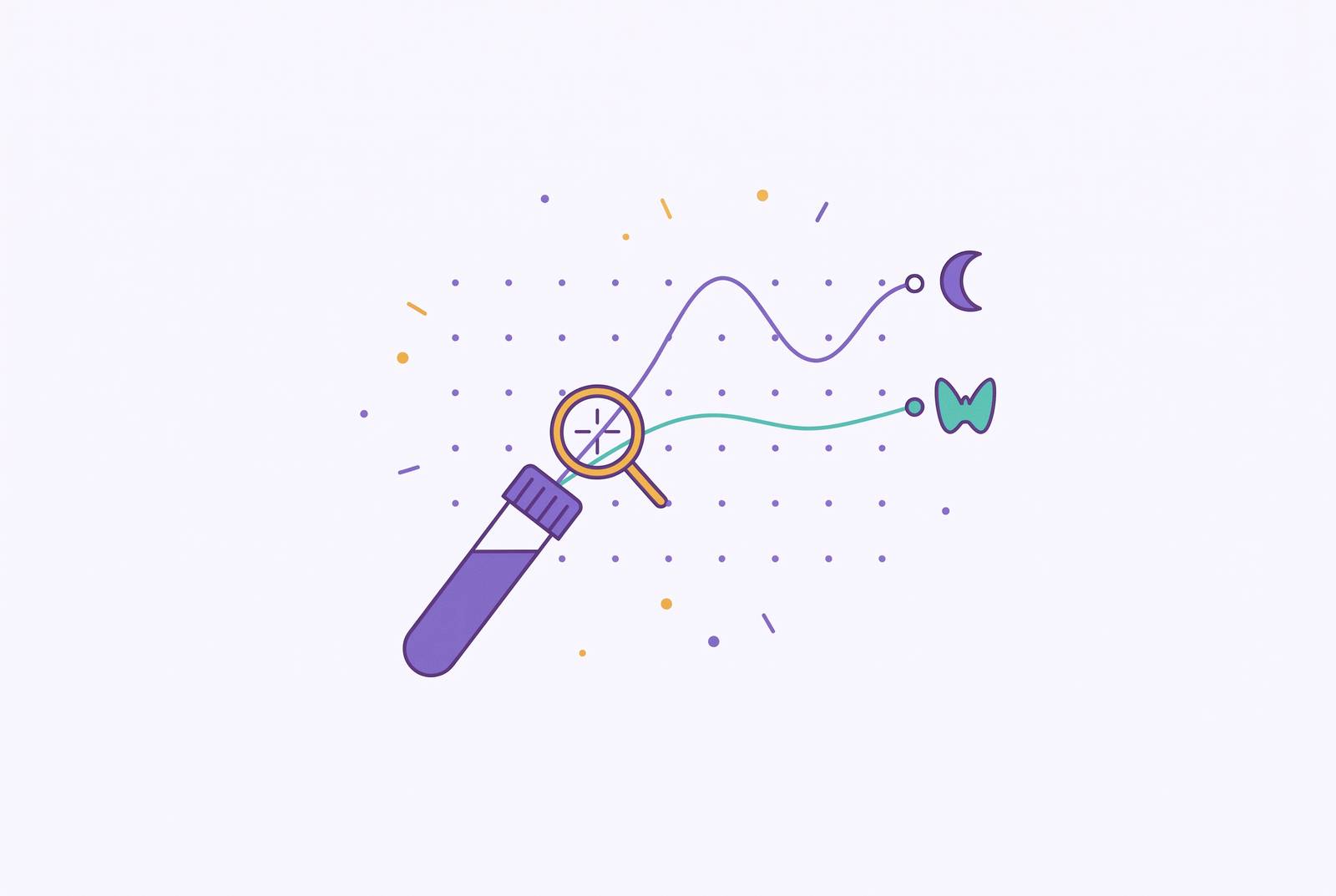
Perimenopause can be mistaken for anxiety, depression, or thyroid disorder because these conditions share symptoms, while a normal hormone result can obscure the transition. Distinguishing them requires clinical history. When thyroid dysfunction is a plausible alternative or coexisting condition, selective, paired lab trends can show how reproductive and thyroid hormones move together and give dismissed symptoms a clearer clinical context.
Why perimenopause and thyroid disorder are so hard to tell apart at first presentation
Fatigue, sleep disruption, mood changes, cognitive difficulties, weight fluctuations, palpitations, and irregular periods occur in both perimenopause and thyroid dysfunction. The overlap leaves few reliable shortcuts at an appointment. Cleveland Clinic’s perimenopause overview lists irregular periods, mood changes, insomnia, and hot flashes as the main symptoms. Yet an underactive or overactive thyroid can produce much of the same clinical picture, so recognizing a familiar symptom cluster does not establish its cause.
Hypothyroidism typically produces cold intolerance, while perimenopause more often produces heat intolerance and hot flashes. Hyperthyroidism weakens that distinction because it, too, can cause heat intolerance. Thyroid disorders affect roughly one in eight women, and their prevalence rises with age, bringing them into increasing overlap with the menopausal transition. The two conditions also frequently coexist, so confirming one cannot eliminate the other.
Why a single hormone draw cannot resolve the question
The defining feature of perimenopause is fluctuation. That distinction explains why the usual sequence of ordering a test and comparing it with a reference range can mislead. In early perimenopause, elevated follicle-stimulating hormone, or FSH, can overstimulate remaining follicles, producing higher-than-normal estradiol. Estradiol then suppresses FSH through negative feedback. The FSH value can then look normal even while the hormonal disruption goes on.
What, then, does a normal result establish? A woman can have a menopausal-range FSH in one cycle, ovulate normally in the next, and return a premenopausal value the following month. Progesterone adds another complication because it depends on ovulation, which becomes intermittent before estrogen production becomes consistently low. Its decline can therefore signal the transition earlier than estrogen or FSH.
Thyroid-stimulating hormone, or TSH, has its own limitations. Oral contraceptives and oral hormone therapy also increase thyroid-binding proteins, which can temporarily distort thyroid test results. Leading guidelines accordingly treat perimenopause as a clinical diagnosis, with no definitive single-draw threshold that separates the transition from normal cycling.
What the hormonal pattern of perimenopause looks like across multiple draws
Across multiple draws, perimenopause is better understood as erratic hormonal change than as a smooth descent toward low estrogen. FSH rises and dips before trending upward over months to years, while estradiol can swing widely. Progesterone declines earlier as ovulation becomes intermittent. A series is useful when it shows how these hormones change together, beyond showing which results fall outside a laboratory range.
The STRAW+10 framework uses changes in menstrual cycles as the main way to define the stages of reproductive aging. It identifies early transition by a seven-day-or-greater change in cycle length and late transition by an absence of periods for 60 days or more. FSH above 25 IU/L is characteristic of the late transition, but variability limits its use as an isolated dividing line. Menstrual history remains central to interpreting the result. An elevated FSH followed by a lower value need not contradict the transition when the cycle history and wider pattern fit.
Estradiol requires the same attention to movement. There is no stable perimenopausal “normal range” that can settle the question, because values may be high in one cycle and low in another. Anti-Müllerian Hormone, or AMH, offers a different kind of information by reflecting the remaining ovarian follicle pool without the same cycle-related fluctuation. For women with low values, it predicts time to menopause better than FSH, but individual prediction intervals span years. It does not measure symptom severity or provide a standalone diagnosis.
FSH and estradiol show changing ovarian feedback, progesterone adds information about the earlier loss of consistent ovulation, and AMH adds an ovarian reserve signal. LH may also be included in a reproductive hormone assessment. Where cortisol dysregulation is part of the differential diagnosis, diurnal cortisol can add context because its symptoms overlap too. That broader context helps guide which markers to check, though every woman with symptoms may not need them all measured.
What the thyroid panel adds and how its trends differ
A thyroid assessment asks whether thyroid dysfunction occurs alongside what looks like the reproductive transition or explains it instead. A TSH-only screen cannot answer every version of that question. A fuller panel includes TSH, free T4, free T3, anti-TPO antibodies, and anti-thyroglobulin antibodies. The antibodies can be elevated years before TSH leaves its standard range. Consequently, normal TSH does not exclude early Hashimoto’s thyroiditis, although an antibody finding and current thyroid dysfunction are not interchangeable conclusions.
In perimenopause without thyroid dysfunction, FSH rises erratically, estradiol swings widely, and progesterone tends to be low, while thyroid markers remain stable or show age-related TSH drift. In thyroid dysfunction without perimenopause, TSH instead moves directionally, rising in hypothyroidism or falling in hyperthyroidism, while reproductive hormones remain appropriate for cycle phase. Thyroid antibodies may remain elevated across draws. When both conditions coexist, both patterns can appear, which prevents either diagnosis from closing the investigation prematurely.
However, finding more thyroid information also creates a responsibility not to overinterpret it. Standard TSH reference ranges run about 0.3 to 4.0 mIU/L, but a woman’s age changes how a clinician should read a result within that range. An upper-normal value is not, by itself, a diagnosis. The British Thyroid Association’s 2022 meeting keynote abstract warned of a rising trend in hypothyroidism overdiagnosis and thyroid hormone use in euthyroid patients. The purpose of paired trends is to distinguish plausible causes more carefully.
What the clinical guidelines actually say about when to test and when not to
Routine reproductive hormone testing is not required to diagnose perimenopause in otherwise healthy women over 45. The National Health Service bases that diagnosis on symptoms and clinical history and does not recommend lab tests to make it. STRAW+10 likewise advises against routine FSH and estradiol measurements to diagnose menopause, providing a substantive objection to indiscriminate testing. Repeatedly measuring fluctuating hormones does not automatically make a clinically apparent transition more certain.
Considering whether another condition may explain the presentation or exist at the same time is a differential diagnosis. Thyroid tests serve a different purpose from reproductive staging, while investigation of adrenal dysfunction or other overlapping conditions depends on what remains clinically uncertain. The distinction changes what useful testing looks like. Where doubt remains, well-chosen tests of both systems, timed to be read together, can help without requiring a full panel before a woman can get care.
Nor does a trend interpret itself. Cycle phase, age, symptoms, and hormonal treatment remain part of the evidence, even when several results are available. Serial draws are useful when they show a pattern that a single result could hide. They are less useful when they repeat what symptoms and clinical history have already made clear. The fair reading of the guidelines is therefore not “test everything” or “test nothing,” but that testing should answer a specific unresolved question.
Why do women reach this conversation after years of perimenopause misdiagnosis?
Perimenopause can be misattributed to anxiety or depression because mood and sleep symptoms are part of the transition itself. If those symptoms are interpreted without the menstrual history, the hormonal context can disappear from the assessment. A normal single FSH result can reinforce that error. Conversely, recognizing anxiety does not establish that perimenopause is its cause. The diagnostic task is to consider the overlap without treating either explanation as an automatic exclusion of the other.
Flo Health’s survey found that 53% of perimenopausal women felt their symptoms were dismissed or not taken seriously. Most women in the survey who felt dismissed waited longer to seek more care, so the effects lasted beyond that appointment. A 2025 study in BMC Women’s Health that used Global Burden of Disease data found that the burden of anxiety disorders among perimenopausal women had risen steadily since 1990 and was expected to keep rising. That finding supports attention to anxiety during this life stage, but does not show that every anxiety diagnosis conceals perimenopause.
Thyroid misattribution can run in either direction. A perimenopausal woman with upper-normal TSH may be treated for hypothyroidism, while a woman with early Hashimoto’s and irregular periods may be told she is simply perimenopausal. Both mistakes can leave women without the care they need for years. The shared mechanism is premature closure around symptoms or a single laboratory result, without enough attention to the other hormone system. A clinical history joined to selective longitudinal evidence offers a way to reopen that reasoning.
How to use serial labs as a practical self-advocacy tool in clinical settings
For a woman facing unresolved symptoms, the practical lesson is to ask what remains uncertain and which measurements could resolve it. An appointment can then focus on whether the evidence supports perimenopause, thyroid dysfunction, or both. A result needs to be assessed for its fit with the symptoms, cycle history, treatment context, and previous findings. A longitudinal record gives the clinician access to evidence that may otherwise be scattered across separate appointments.
Where reproductive hormone testing is clinically appropriate, a proposed starting point for discussion is two FSH and estradiol draws four to six weeks apart, ideally on cycle days 2–5. Their value lies in comparison. Testing thyroid markers at the same time allows both systems to be assessed together. A fuller thyroid assessment can include TSH, free T4, free T3, anti-TPO, and anti-thyroglobulin, depending on what remains clinically uncertain. The clinician can explain which components are needed.
Progesterone deserves discussion when FSH looks normal but the wider history suggests transition, because progesterone can decline first. Persistently low results are potentially informative, but still need interpretation in the context of ovulation and cycle phase. AMH may add a more stable ovarian reserve signal when that information is useful. It cannot explain how severe symptoms should be. Including it in a record should not turn a population-level timing marker into a personal countdown.
The most useful self-advocacy question is therefore specific. How do these results fit together, and what alternative explanation remains untested? Maintaining a record across weeks or months can make an episodic pattern visible to a clinician who otherwise sees only one appointment’s results. If symptoms are dismissed, that record gives a woman evidence to draw on when asking why the proposed explanation fits better than the others. Its purpose is to support a reasoned clinical response.