What Fitbit and Apple Watch Cannot Tell You About Hormonal Health
Wearables track symptoms, not the hormones driving them.
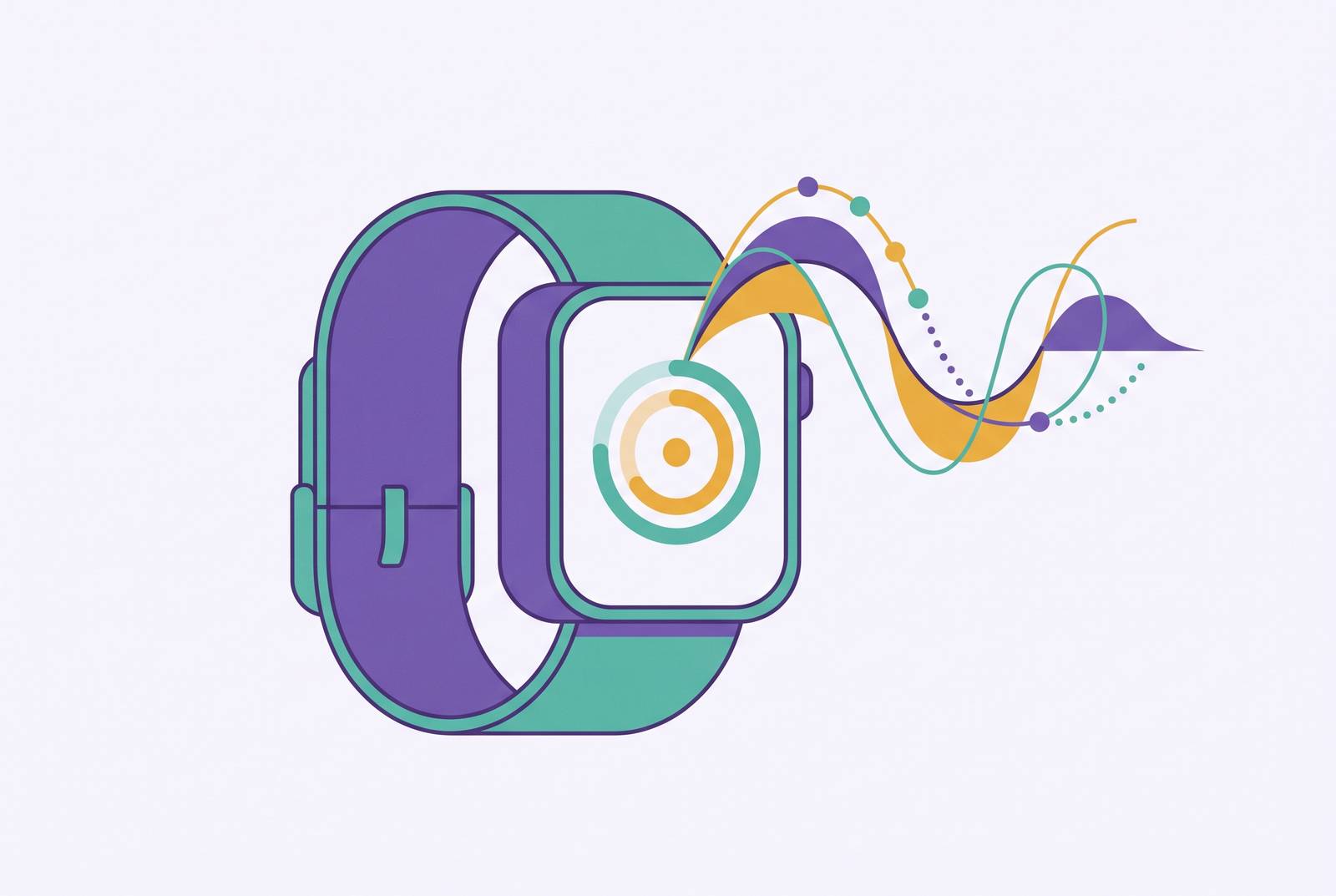
Consumer wearables track a real but narrow slice of human physiology, and the companies that make them are fairly specific about what that slice contains. Devices in this category record ECG readings, sleep stages, wrist temperature baselines, and irregular heart rhythm alerts. Apple Watch Series 9 and later models go further, flagging signs of sleep apnea. Fitbit states in its product documentation that its health metrics "are not intended to diagnose or treat any medical condition. Neither company claims its hardware can measure circulating hormones: not estrogen, not progesterone, not FSH, not LH. That omission is not a gap in engineering ambition so much as an honest description of what a wrist sensor is physically capable of detecting. A woman reading her own sleep and heart rate data is reading something real. She is not reading her hormones, and no marketing claim from either manufacturer suggests otherwise.
The hormones that drive perimenopausal symptoms
What a wearable cannot see is the hormonal biology that produces the symptoms it registers as data. During perimenopause, the ovaries gradually produce less estrogen and progesterone, and as estrogen declines, the balance between the two hormones breaks down. The menstrual cycle becomes erratic, not simply lighter or less frequent. The most biologically active form of estrogen, 17β-estradiol (E2), is produced primarily by the ovaries and drives the vasomotor symptoms most associated with this transition: hot flashes, night sweats, and the sleep disturbances that follow from both. Mood fluctuations trace back to the same decline, since falling estrogen affects serotonin and other brain chemicals involved in mood regulation. Follicle-stimulating hormone, or FSH, rises as the ovaries grow less responsive to its signal. Two FSH readings taken four to six weeks apart, with values above 25 mIU/mL, can indicate premature ovarian insufficiency or an early menopausal transition in women under 45, though this protocol is not used in women over 45, where diagnosis is made clinically instead. Anti-Müllerian hormone, or AMH, reflects how many follicles remain in the ovaries and declines steadily across the reproductive years before dropping more sharply as perimenopause approaches, making it a useful aging marker in the late reproductive stage specifically. No single hormone tells the whole story. A comprehensive panel, covering estradiol, progesterone, testosterone, FSH, LH, DHEA-S, and AMH, offers complementary information about reproductive health, metabolic function, and where a woman sits in the progression of perimenopause. None of it travels through skin contact with a sensor. It requires blood or saliva, drawn and analyzed, which is precisely the step a wearable cannot replicate no matter how many nights of sleep data it accumulates.
Why perimenopausal hormones are especially hard to read from symptoms alone
Perimenopause does not progress on a predictable downward slope, and that irregularity is what makes symptom tracking, wearable or otherwise, such an unreliable narrator. Early perimenopause, classified as STRAW+10 Stage -2, can last several years, during which progesterone declines steadily while estrogen swings erratically, never settling into a consistently low range. Estradiol can rise before it falls, a counterintuitive pattern that means a woman may experience intense hot flashes and night sweats while a single hormone snapshot still reads within normal range. One might argue that this should make symptoms more informative, not less, since the body is clearly signaling distress. But the mismatch between how a woman feels and what one lab value shows is exactly the problem: the symptom persists even though the number that should explain it has not yet moved. Late perimenopause, Stage -1, looks different again, marked by extended stretches without a period at all, which becomes one of the few clinically reliable indicators available at that stage. Even then, the final menstrual period can only be confirmed in retrospect, a full 12 months after it occurs, so the transition cannot be timed or staged from wearable data in real time no matter how closely a woman watches her numbers. The Swiss Perimenopause Study, which followed women aged 40 to 56 for 13 months with repeated hormone sampling, found that making sense of confounding hormone results requires longitudinal, standardized assessment, because estradiol levels fluctuate and can even increase during perimenopause. A wearable can detect the aftermath of a night sweat: an elevated heart rate, a disrupted sleep stage, a spike in wrist temperature. It cannot tell a woman whether that aftermath came from hormonal flux, thyroid disease, anxiety, or undiagnosed sleep apnea. The signal and its cause are two different things, and the wearable only ever has access to the first.
The overlapping conditions that make symptom-reading even less reliable
The diagnostic difficulty compounds once other conditions are added to the picture, because perimenopause shares its most associated symptoms with several other conditions. Fatigue, disrupted sleep, heart palpitations, weight changes, heat intolerance, cognitive fog, irritability, and mood swings can arise from reproductive aging, thyroid disease, a psychiatric disorder, chronic stress, a sleep disorder, or some combination of several at once. Thyroid conditions illustrate the overlap well. Hypothyroidism and hyperthyroidism both share fatigue, weight changes, mood swings, hair thinning, and temperature dysregulation with perimenopause, though dry skin and brain fog lean more specifically toward hypothyroidism, while sweating, palpitations, and nervousness point more toward hyperthyroidism. When a thyroid condition and perimenopause occur in the same body at the same time, symptoms are easily credited to only one cause when two are actually in play. Anxiety disorders present a similar trap. Labeling a woman's experience as "just anxiety" when it is perimenopausal in origin can lead to incomplete treatment, symptoms that persist despite medication, and missed attention to bone, cardiovascular, and metabolic changes that need addressing in their own right. Research into the global burden of anxiety disorders during perimenopause has found that the transition itself raises the risk of anxiety disorders, largely because hormonal shifts disturb the body's regulatory feedback systems, which makes the two conditions genuinely difficult to pull apart. Separating them calls for a systematic, evidence-based approach rather than a reading of symptom patterns or a scattershot run of unrelated lab tests. A wearable that flags an elevated resting heart rate and a night of broken sleep has no mechanism for distinguishing among these causes. It hands the data back to the woman wearing it, and she is left exactly where she started: aware that something is happening, with no way to say what.
Why a single hormone test is not enough either
It would be reasonable to assume that a hormone test, unlike a wearable, finally gives a clear answer. It gives an answer, but a partial one, and that limitation deserves as much attention as the wearable's. Female hormones shift across the menstrual cycle, and testing is typically recommended on cycle days three through five, when hormone levels are closest to baseline and results are easiest to interpret accurately. Standard clinical appointments are rarely built around that timing. Many women are tested whenever an appointment happens to land, regardless of whether that timing is when the result will mean the most. Because estradiol can spike before it declines, a single in-range result drawn during early perimenopause can reassure a patient and her clinician in a way that does not hold up over the following months. The FSH protocol built for women under 40, or for those aged 40 to 45 where the diagnosis is uncertain, calls for two readings taken four to six weeks apart. For women over 45, major guidelines favor a clinical diagnosis over routine FSH testing altogether, and most routine appointments are not structured to accommodate either approach. Meanwhile, symptom burden, bone density trajectory, and cardiovascular risk all shift gradually across a transition that can run several years, in ways no single lab draw, however well timed, is built to capture. The Swiss Perimenopause Study's design, with repeated saliva sampling across 13 months, was built around exactly this limitation: the pattern across time, not the value recorded on any one day, was what revealed what was actually happening hormonally in each woman studied.
Tracking Hormone Levels Over Time
Repeated measurement is what turns a single confusing result into something a woman can actually use. A series of FSH values recorded across several months shows directional movement, whether rising, plateauing, or still bouncing around, in a way that no isolated reading can demonstrate on its own. Tracking estradiol and progesterone alongside a symptom log lets a woman and her clinician tell a transient estradiol spike apart from a sustained decline, and to line up specific hormonal shifts against specific changes in how she feels. AMH adds a different kind of thread, since it declines steadily rather than swinging cycle to cycle, offering a longitudinal marker of ovarian reserve that complements the more erratic behavior of estradiol and FSH. The stakes extend beyond day-to-day symptom relief, too. Bone mineral density loss and cardiovascular risk both accelerate during and after the transition, so knowing when hormonal shifts are actually occurring carries clinical weight that has nothing to do with whether a given week feels comfortable. The 2026 Levels Guide to female hormone tests makes a point that reframes much of this discussion: hormone testing for women is not a standard part of routine medical care, and the responsibility for seeking it out typically falls on the woman herself. That fact changes how self-initiated, trackable testing should be understood: it is often how the data gets collected.
Why women often arrive at this point without the data they need
None of this happens in a vacuum: the reasons women so often reach this stage without adequate hormonal data are structural. Perimenopause can begin as early as a woman's mid-30s, typically starts in the mid-40s, and can last as long as eight years, yet the transition remains poorly recognized across much of clinical practice. The prevailing clinical approach, which treats diagnosis as primarily a matter of symptoms plus menstrual history, works reasonably well once periods have become visibly irregular. It fails women earlier in the process, when cycles have not yet shifted and symptoms are instead being absorbed into a thyroid workup or an anxiety diagnosis that may only be telling part of the story. A symptom-based approach anchored to irregular bleeding as the entry point structurally delays attention to bone density loss, vasomotor instability, and other changes that benefit from being addressed while the transition is still underway. Into that gap steps the wearable, offering the appearance of health data: a graph, a trend line, a notification that something has changed. That data answers a different question than the one a woman in this position is actually asking. She wants to know why her body is behaving this way, and the wearable was never built to tell her.
What a Woman Can Reasonably Do With Wearable Data
None of this makes the wearable useless. CUT Where the usefulness runs out is at the explanatory level: a wearable describes the downstream effects of hormonal change without touching the cause behind them, and it has no way to separate perimenopause from thyroid dysfunction, from anxiety, or from the three occurring together. The practical next step is hormone testing, timed to the appropriate point in the cycle, repeated over months rather than drawn once, and interpreted by a clinician who reads the results against symptoms and history. Cleveland Clinic notes that because perimenopause symptoms resemble those of other conditions, talking with a healthcare provider matters: that provider can confirm whether symptoms trace back to perimenopause or to something else. UC Davis Health makes a related point: determining whether a woman is in the menopausal transition can be genuinely difficult even for her provider, who typically draws on age, symptoms, and family history to make that judgment, context that structured hormone data sharpens. A woman who arrives at a clinical appointment with months of tracked hormone values showing a clear directional trend is in a materially stronger position than one relying on a wearable's symptom log alone. The wearable can tell her something changed. Only the hormone data, gathered with the right timing and tracked long enough to show a pattern, can tell her why.
Sources
- Perimenopause, menopause and postmenopause: What to know and how to treat the symptoms
- Perimenopause: Age, Stages, Signs, Symptoms & Treatment
- Global, regional, and national burden of anxiety disorders during the perimenopause (1990–2021) and projections to 2035
- Steroid Hormone Secretion Over the Course of the Perimenopause: Findings From the Swiss Perimenopause Study
- Global, regional, and national burden of anxiety disorders during the perimenopause (1990–2021) and projections to 2035