How to Request Hormone Testing Through a Physician When Insurers Require It
A symptom log and clinical framing help patients navigate insurer and physician barriers to testing.
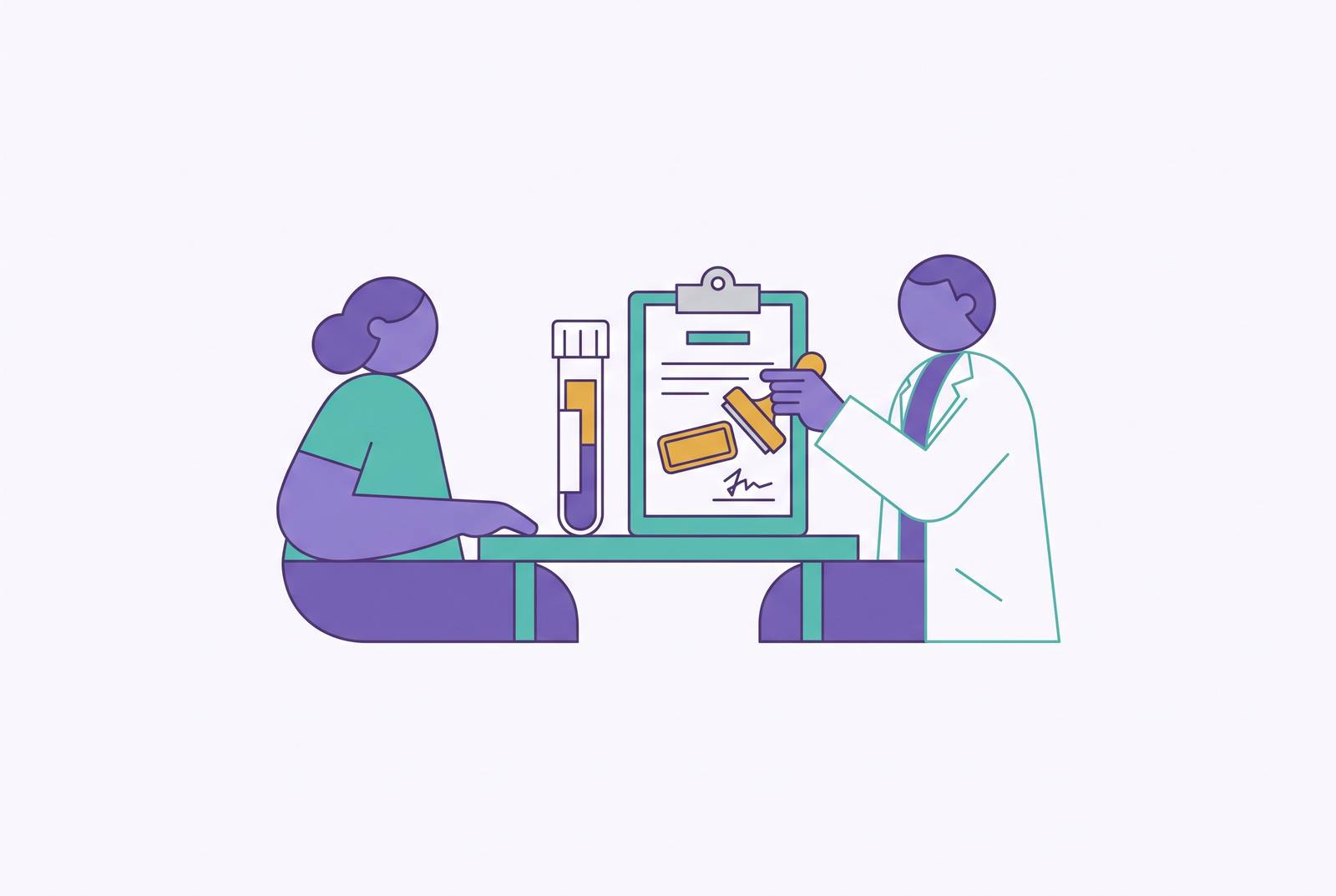
Most private insurers will not cover hormone testing without a physician order and documented medical necessity attached to it. That requirement is a coverage architecture decision, built to control what gets paid for and under what conditions, not a clinical judgment about whether a given woman's symptoms warrant a blood draw. For a woman already experiencing hot flashes, disrupted sleep, or cycles that no longer behave the way they used to, that distinction matters less in the moment than the practical effect: she needs a diagnosis-shaped request before she can get the test that would help confirm or rule out the diagnosis. New York's Assembly Bill A5444A, introduced in the 2025-2026 session, proposes to extend mandatory coverage requirements statewide for perimenopausal and menopausal care and treatment broadly, not hormone therapy alone, which suggests lawmakers have noticed the same gap this article addresses. Illinois and Louisiana were among the earliest states to mandate coverage and prohibit prior authorization requirements for hormone therapy specifically, and by 2026 New Jersey, Oregon, and Washington had joined them with their own mandates. Seeing the barrier as procedural rather than medical changes the question a woman needs to answer: not whether testing is justified, but how to satisfy the specific documentation criteria an insurer and an ordering physician both require before that justification counts.
Perimenopause's Biology and Insurer Documentation
Perimenopause is defined by hormonal fluctuation, not a stable deficiency state, and that single fact creates most of the friction described above. An insurer's documentation framework generally expects a lab value that falls outside a normal range as evidence of a problem, but a woman in the middle of a significant perimenopausal transition can have a hormone panel come back entirely unremarkable on the day it happens to be drawn. FSH, the single marker most commonly ordered, can shift from elevated to normal within days, and a single normal FSH result has in practice been used to dismiss symptoms that were genuinely rooted in perimenopause. Research on perimenopause management describes markedly erratic and declining serum concentrations of 17β-estradiol, alongside shifting progesterone and FSH, as the actual hormonal signature of this life stage. Variability is the signal that something is happening. A woman whose panel returns within normal limits on a given draw date has not been cleared of perimenopause. She may simply have been tested during a quiet window of a hormonal pattern that a longitudinal record, taken across weeks or months, would reveal far more clearly than any single draw can. That gap, between how insurers are built to read a lab result and how perimenopausal hormones actually move, is what the rest of this guide exists to help a woman prepare for and close.
The Complete, Insurer-Legible Hormone Panel
Knowing what a complete panel looks like before walking into an appointment gives a woman something specific to request, and something to fall back on if a physician proposes a narrower order than the symptoms seem to warrant. A thyroid hormone test belongs in that panel because thyroid dysfunction overlaps so heavily with perimenopausal symptoms: fatigue, mood disturbance, menstrual irregularity, weight changes, and cognitive difficulty can originate from either condition, or from both at once. The case for going beyond FSH alone is strong on clinical grounds, too. Perimenopause management literature identifies real limitations in using FSH as a standalone marker, given its indirect correlation with the actual decline in ovarian function it is meant to track, which supports asking for a broader panel rather than accepting a single FSH draw as sufficient. Timing matters as much as panel composition. Hormone levels in a cycling woman vary by cycle day in predictable ways, and a draw taken on an uninformative day can produce a result that neither confirms nor rules out anything useful. Arriving at the appointment with a basic understanding of why cycle-day-specific testing matters is not a matter of directing the physician's order from the outside, it gives the physician something concrete to work from, and it reduces the odds of a draw that comes back effectively unreadable.
Building a Symptom Record for Documentation
Because a single lab snapshot carries so little weight in a condition defined by fluctuation, a dated symptom log is arguably the single most useful document a woman can bring into a physician's office. The log needs to be specific enough to function as evidence, not just a diary of how a week felt. "Mood changes" tells a physician almost nothing actionable. "Severe irritability and disrupted sleep on days 18 through 22 of cycle, recurring for four consecutive cycles" tells a physician what pattern to look for and how long it has persisted, turning a symptom note into a piece of documentation an insurer can weigh. The categories that matter to track systematically mirror what perimenopause research identifies as the full symptom picture: vasomotor symptoms such as hot flashes and night sweats, sleep disruption, mood changes, fatigue, concentration difficulties, changes in the menstrual cycle itself, and changes in sexual health. Menstrual cycle changes deserve particular attention in the log because they are themselves diagnostic information, not just background noise. Cycles that shorten, then begin skipping, then stretch out again, with that instability as the pattern rather than any single length, are a recognized clinical signal of the perimenopausal transition. Prior test results belong in this record too, even an old normal FSH reading that once seemed like a dead end. Folded into a longitudinal log, that same result becomes a data point showing what the hormonal picture looked like at an earlier stage.
Framing the Clinical Conversation for an Approvable Order
A physician who is uncertain about perimenopause, or who received limited training in managing it, is far more likely to write a defensible order when a patient frames her request in clinical terms rather than presenting it as a personal conviction about what is wrong. A 2025 qualitative study published in the British Journal of General Practice, which involved 11 GPs, found that the physicians themselves acknowledged gaps in their training on perimenopause and reported using inconsistent approaches to asking about perimenopausal symptoms. One might argue this puts an unfair burden on the patient to raise a connection her own physician should be trained to notice, and that is a fair criticism of the system. But it also means a patient who raises the connection explicitly, rather than waiting for the physician to make it, meaningfully improves her odds in that specific appointment. A framing like "I want to rule out thyroid dysfunction and assess whether my hormone levels are consistent with perimenopause, given these symptoms over this period of time" functions as a clinical request built around a differential diagnosis, not a self-diagnosis handed to the physician for a signature. Asking for a full panel rather than a single marker becomes easier to justify when it rides alongside an uncontroversial request like ruling out thyroid disease, since the hormone panel follows the same diagnostic logic. Women in their early 40s run into an additional obstacle: dismissal on the grounds of being "too young" for perimenopause. Perimenopause can begin a decade or more before the final menstrual period, and the STRAW+10 clinical framework explicitly recognizes early-stage perimenopausal changes in menstrual cycle variability as a legitimate marker of the transition, which gives a woman facing that dismissal specific language to push back with rather than a vague sense that something is being overlooked. When a physician still hesitates, asking directly what documentation would be needed to write the order turns a stalled conversation into a collaborative one and surfaces the actual gap that needs filling. Some physicians will decline regardless of how well the conversation is framed, and that outcome does not mean the process has failed. It means the next stage of the process, covered below, becomes relevant.
What prior authorization requires and how to make sure the submission is complete the first time
Once a physician agrees to order testing, the next hurdle is getting that order covered, and prior authorization approval depends heavily on the completeness of the submission rather than on the clinical merits of the request alone. Incomplete submissions are a primary driver of initial denials, which makes this stage as much about paperwork discipline as it is about medicine. A complete prior authorization submission for hormone testing needs to connect three specific things: documented symptoms that affect quality of life, lab results or a clear clinical rationale for why testing is needed to establish a baseline where no prior results exist, and a stated diagnostic or treatment plan that the testing is meant to serve. The physician's office is usually the party that submits the paperwork, but the patient still has a role to play in making sure the symptom documentation built over the preceding weeks actually reaches the physician and gets referenced in that submission. Coding accuracy matters at this stage in ways that are easy to overlook from outside the system. The diagnosis code for the underlying condition, such as menstrual irregularity or perimenopausal symptoms, has to pair correctly with any code tied to proposed hormone replacement therapy, and a mismatch between the diagnosis code and the proposed treatment is one of the more common triggers for a denial that has nothing to do with whether the testing itself was appropriate. It helps to ask the physician's office for the prior authorization tracking number along with an expected response timeline, and to follow up before that deadline lapses rather than waiting passively for a denial notice to arrive.
What to do when a first request is denied
A first denial is a procedural outcome, and it is frequently reversed on appeal once the medical documentation behind it is made complete. Treating a denial as a final verdict, rather than as one step in a longer process, is probably the single most costly mistake a woman can make in this entire process, because it is the point at which many people simply stop. The appeal process has a defined structure that does not depend on guesswork: an internal appeal filed with the insurer comes first, and if that fails, federal law gives most plans a right to external review by an independent third party outside the insurer's own system. A strong appeal letter does something the original submission may not have done explicitly. It connects each documented symptom to the specific test being requested, demonstrating that the test is medically necessary to evaluate or rule out a defined diagnosis. A physician willing to act as an advocate at this stage makes a measurable difference: a letter of medical necessity written specifically for this patient, addressing the insurer's stated reason for denial directly rather than reading like a generic form letter, is consistently the most effective single addition to an appeal file. If both internal and external appeals fail, filing a complaint with the state insurance commissioner is a documented escalation path, and some denials are overturned at this stage, particularly when the insurer's stated rationale appears to conflict with a state coverage mandate already on the books. None of this guarantees an outcome, and it would be dishonest to suggest otherwise. But it does mean the barrier described at the start of this article, a procedural one rather than a medical one, can be worked through methodically, and women who move through each step with documentation in hand have a materially better chance of getting the testing they need than those who stop at the first no.
Longitudinal Hormone Tracking as an Evidence Base
A single approved hormone panel answers a question about one moment. A series of panels drawn over months reveals the fluctuating pattern that actually defines perimenopause, which is precisely what a one-time snapshot test is structurally unable to capture. Each additional test adds to a documented medical record that supports the next physician conversation and the next prior authorization submission, so the evidence base grows rather than resetting to zero every time a new question comes up. Tracking results over time also puts a woman in a position to notice when her own hormonal picture is genuinely shifting, from a pattern of variability toward something like consistently low FSH suppression, for example, and to bring that pattern to a clinician as a dated, concrete record rather than a description of how she has been feeling. That distinction matters clinically as well as administratively: serial testing interpreted by a clinician with specific expertise in perimenopause is a meaningfully different tool than a single panel ordered once by a general physician, because understanding what a pattern means over time requires clinical context that no isolated result, however normal or abnormal, can supply on its own.
Sources
- NY State Assembly Bill 2025-A5444A
- Mental health consultations during the perimenopausal age range: a qualitative study of GP and patient experiences
- Management of the Perimenopause - PMC - NIH
- Mental health consultations during the perimenopausal age range: a qualitative study of GP and patient experiences