Saliva and Urine Hormone Tests vs Blood Panels
Blood, saliva, and urine tests measure different hormone fractions with different clinical uses.
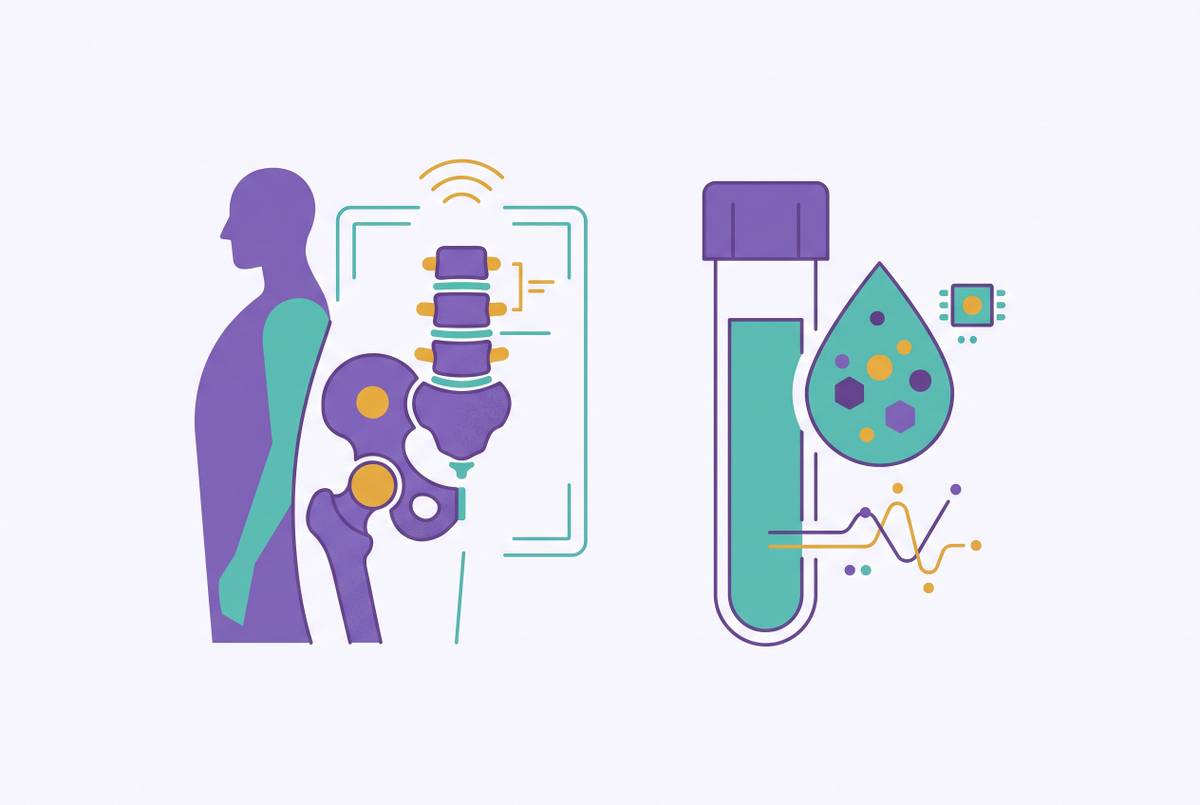
Perimenopause doesn't lower hormones on a smooth downward slope. It swings, sometimes sharply, sometimes within the same week, and that instability is what makes hormone testing during this transition so hard to interpret correctly. Blood, saliva, and urine tests don't just collect samples through different methods, they measure entirely different hormone fractions, and knowing which fraction you're looking at is what separates a useful result from a misleading one.
Perimenopause typically spans roughly 4 to 10 years, with the National Institute on Aging noting that symptoms can persist for 2 to 8 years before the final period arrives. Early on, cycles start changing and progesterone is usually the first hormone to drop. Later, estrogen trends down overall but keeps jumping around unpredictably, ovulation gets sporadic or stops, and progesterone runs low, which is often when symptoms hit hardest. A study in npj Women's Health, run by researchers at UVA Health and Flo Health, found that 55.4% of women between 30 and 35 reported moderate to severe perimenopausal symptoms on the Menopause Rating Scale. That's a decade earlier than most people assume this process even starts.
None of this is a testing error. A hormone panel drawn on a Tuesday can look nothing like one drawn two weeks later, and that's just what the biology is doing. So the real question is which test answers the question actually being asked, given what the body is doing at that particular moment." It's which test answers the question actually being asked, given what the body is doing at that particular moment.
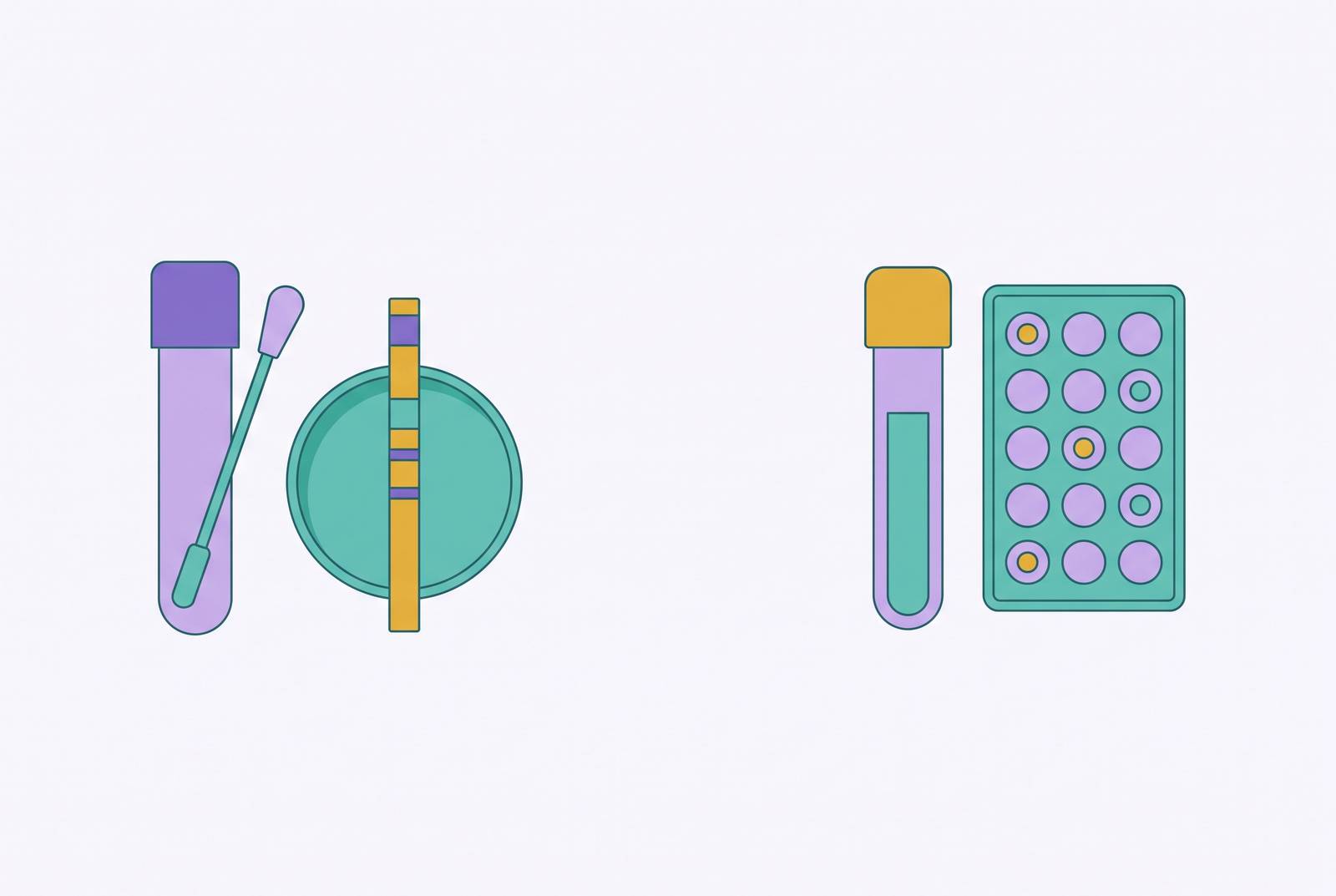
What each sample type measures, and how that differs by design
Blood, or serum, testing measures total circulating hormone. That includes hormone bound to carrier proteins like SHBG (sex hormone binding globulin) plus the smaller free fraction that's actually available to act on tissue. SHBG binding matters because it determines how much of that total number is biologically active versus just along for the ride in the bloodstream.
Saliva testing measures only the free, unbound fraction, the portion of steroid hormone that's already crossed out of the blood and become available to enter cells. Proponents argue this is a more honest picture of what tissue is actually exposed to, since it skips the bound hormone that isn't doing anything yet.
Urine testing measures something different again: metabolites, the breakdown products left after the body has already processed the hormone. That's not a snapshot of what's circulating right now, it's a record of what's already been used and excreted. Because urine captures a downstream biological event rather than a live one, it can reveal how the body is metabolizing hormones, a question saliva simply can't answer.
None of these three is wrong. They're answering three different questions, and the section that follows walks through where each one earns its keep and where it doesn't.
What blood panels do well in perimenopause
Blood remains the clinical reference standard, the format most guidelines and most physicians build their thinking around. Part of the reason is efficiency: one draw can return a wide panel at once, estradiol (E2), FSH, LH, progesterone, SHBG, TSH, AMH, all from the same vial.
That TSH inclusion is doing real work. Thyroid dysfunction produces fatigue, mood swings, and weight changes that overlap heavily with perimenopausal symptoms, so a single blood draw can rule out a thyroid problem at the same time it's checking reproductive hormones. That's a meaningful efficiency a urine or saliva panel doesn't replicate.
FSH timing, though, is specific and often gets skipped. Clinical guidance generally recommends drawing FSH early in the cycle, or after a prolonged gap without a period, to improve the reliability of the result. The number becomes harder to interpret if that window is missed, because FSH fluctuates week to week and can drop back into premenopausal range even in a woman who is clearly transitioning. One elevated reading doesn't confirm perimenopause. One normal reading doesn't rule it out either.
Here's a detail that surprises a lot of women: estradiol concentrations during perimenopause average approximately 20% to 30% higher than premenopausal levels. That cuts against the assumption that "low estrogen" is the perimenopausal story from day one. A blood test that captures only a single day isn't an effective way to diagnose perimenopause on its own, because fluctuation means this week's number can flatly contradict next week's.
What a clinician-ordered blood panel adds that no at-home kit can replicate is context: cycle history, current medications, symptom pattern, all of which shape how a result gets read and whether it's worth retesting in a month. A 2026 study in Chinese Medical Journal, drawing on 10,543 women, built standardized age-specific reference percentiles for AMH (anti-Müllerian hormone) and found that women in the lower AMH percentiles reported more severe symptoms, particularly vasomotor ones like hot flashes. That's a layer of information FSH by itself doesn't provide. Estrogens, androgens, and hormonal contraceptives can all shift FSH results, so anything being taken needs to be disclosed before the blood draw, not after.
Saliva testing: what it captures and where it misleads
Saliva measures the free, bioavailable fraction of steroid hormones, which has already made its way into tissue. Some practitioners argue that for hormones like cortisol and progesterone, this fraction is more clinically meaningful than a total serum number, since it reflects what's actually reaching cells rather than what's sitting bound in the bloodstream.
The practical case for saliva is straightforward. It's non-invasive, it can be done at home, and because it's simple to collect, it can be sampled multiple times across a single day or across a whole cycle. That last point is genuinely useful: daily saliva sampling has a real application in mapping how hormones move across a cycle, something one blood draw structurally cannot do. Research from IBL International and Tecan, reported by News-Medical, found that daily saliva sampling can pinpoint hormone imbalances with more precision than one or two isolated samples.
But how much does that advantage hold up once real-world conditions get involved? Saliva results are sensitive to a range of everyday variables, including food and caffeine intake, which can shift readings meaningfully. Samples need to go into a freezer immediately or the readings drift. And there's a delivery-method problem that trips up a lot of women on hormone therapy: saliva testing is not considered reliable for all forms of hormone delivery, as certain methods can produce readings that don't reflect whole-body exposure.
Current clinical practice guidelines don't recommend salivary testing for diagnosing menopause, a point raised in clinician commentary on hormone testing. Clinician commentary on saliva-based cycle tracking notes that the method has not yet demonstrated sufficient reliability for conclusive tracking of menstrual fluctuation.
The paradox with saliva in perimenopause is that its best feature, the ability to sample daily, runs headfirst into its worst feature, sensitivity to everyday variables like coffee and stress. That pre-analytical noise layers on top of hormones that are already swinging unpredictably, making interpretation murky fast.
Urine testing: what FSH strips and metabolite panels are telling you
Two very different products get lumped together under "urine testing," and they shouldn't be. One is the over-the-counter FSH strip, like the Clearblue Menopause Stage Estimator, which runs about $20 at Walmart according to a Yahoo Health roundup. It measures urinary FSH as a stand-in for menopausal stage, and it gives a result in minutes. The other is a broader urinary metabolite panel, of the kind sold under one branded testing model, which captures a wider range of hormone breakdown products over a collection window.
An FSH strip tells you one narrow thing: that FSH was elevated in that particular urine void. It does not tell you, with any certainty, that perimenopause is underway. FSH fluctuates enough that a negative strip result doesn't rule anything out. Hormonal contraception suppresses FSH entirely, so the strips carry no diagnostic value for women using birth control, a point Forth's clinician commentary makes directly. Pregnancy and various medications distort the picture further. Dr. Alicia Robbins, an ob-gyn and Certified Menopause Society Practitioner at The Elm Greenwich, told Yahoo Health in 2026: "As providers, we generally don't rely on urine menopause test kits... results need to be interpreted with caution."
Where urine earns a real place in the testing toolkit is metabolite panels. Urine is the only one of the three sample types that shows how the body is processing and eliminating hormones, the metabolic pathway itself, not just a circulating number. That's a genuinely different piece of information than either blood or saliva provides. Cortisol is a good example of how the timing differs across methods: urinary free cortisol reflects an average output across the hours since the last void, while saliva captures a single instant. Different clinical questions call for different timescales, and neither is universally better.
The limitations, though, are specific and important. Urine cannot accurately assess topical hormone uptake, and vaginal hormone delivery carries a real risk of contaminating the sample, which tends to produce false-high results. And a urine panel that measures FSH alone, without estradiol, progesterone, or LH, is a poor stand-in for a full picture of perimenopause. It's one data point dressed up as a diagnosis.
How supplementation method changes which test is valid, a dimension most women never consider
Here's a detail most at-home testing products don't put front and center: a large share of women in perimenopause are already on some hormonal product, whether that's contraception, hormone therapy, or an over-the-counter supplement, and the delivery method of that product determines which test format can even produce a valid reading.
Blood spot and saliva both hold up reasonably well across oral, topical, vaginal, injectable, and pellet delivery methods. But saliva has recognized limitations for certain hormone delivery methods, where local exposure can inflate the reading beyond what's actually circulating in the body. Urine has its own blind spot: it can't reliably assess topical hormone delivery, and it can produce distorted readings depending on the medication form involved. Vaginal delivery tested through urine carries a real contamination risk, which can compromise the validity of the result.
Picture a woman using a topical progesterone cream who takes a urine test. The result might look normal, or it might look wildly abnormal, and neither outcome would necessarily reflect her actual hormone status. That mismatch is why clinician review isn't a nice-to-have here, it's the mechanism that catches the problem. A provider who knows what's being taken, how it's delivered, and whether the test format chosen can even generate valid data under those conditions is doing something an algorithm reading a raw number cannot do. And this compounds the FSH issue from earlier: Estrogens, androgens, and hormonal contraceptives can all alter FSH results, so what a test shows may reflect the medication, not the underlying transition.
Why repeated testing over time reveals what any single method misses
Every one of these three formats shares the same core weakness: perimenopause is defined by fluctuation, and a single sample only captures one frozen moment inside a system that refuses to sit still.
FSH is the clearest example. FSH levels can shift week to week, even day to day, sometimes dropping back into premenopausal range. A reassuring result this month might mean very little by next month. That's not a flaw in the test, it's a property of the biology the test is trying to measure.
Saliva's instinct toward daily sampling across a cycle is, in principle, the right response to this problem. Repeated measurement is how you'd want to approach a moving target. The trouble is that saliva's pre-analytical noise (the caffeine, the gum health, the mood swings) undercuts the reliability of each individual sample, so even a sound strategy gets compromised by an unreliable instrument.
Blood panels, repeated at consistent points across different cycles or months, offer something no single draw can: a trajectory. Is estradiol trending down over six months? Is FSH creeping upward? Is the ratio between estrogen and progesterone shifting in a consistent direction? Progesterone in particular needs to be tracked over time rather than checked once, because it's only produced after ovulation, and in early perimenopause that same cause lets a cycle look hormonally "normal" on paper while it quietly erodes luteal-phase progesterone.
Estrogen doesn't have to be elevated to cause symptoms. If progesterone has dropped low enough, estrogen ends up functionally unopposed, even at a number that looks unremarkable on a lab report. The only way to catch that dynamic is by tracking the ratio across multiple cycles, not by reading one value in isolation.
AMH adds a complementary longitudinal thread. The 2026 Chinese Medical Journal study included a longitudinal arm of 2,521 women and found that those with AMH below the 10th percentile at baseline experienced a faster decline before age 40, a pattern that only becomes visible when measurements are taken repeatedly over time. A single AMH value can't show a rate of change. Serial values can.
What ties all of this together is clinician review. A provider looking at a series of results, set against a symptom timeline and prior lab values, is doing something categorically different from an algorithm scoring one snapshot. One is pattern recognition. The other is a guess dressed up as a data point.
Choosing the right test for where you are in the transition
No single format wins across the board. The right test depends on what question is being asked, which hormones actually need measuring, and what, if anything, is currently being taken.
For an initial workup or a first attempt at figuring out what's going on, blood remains the strongest starting point. It covers the widest range in one draw, estradiol, FSH, LH, progesterone, SHBG, TSH, AMH, and it does so with the highest reliability of the three methods. Timing still matters here: clinical guidance calls for FSH testing early in the cycle, or after a prolonged gap without a period, and drawing outside that window weakens the result no matter how good the lab is. The TSH inclusion also earns blood a real edge for initial evaluation, since ruling out a thyroid issue at the same visit is something urine and saliva formats don't offer.
Women on hormonal contraception should be cautious with at-home urine FSH strips specifically, since contraception suppresses FSH and any reading reflects that suppression rather than the underlying transition. A blood panel, read with full clinical context, is the more reliable route there.
For women already on hormone therapy, the delivery method decides the test format. Topical or vaginal hormones call for blood or saliva, not urine. Sublingual or troche delivery presents reliability concerns for saliva testing, since local exposure may skew readings. Oral delivery works reasonably well with either blood or saliva, though urine can distort the picture.
And for tracking change over months rather than capturing a single moment, serial blood panels, drawn at consistent points in the cycle and interpreted against prior results by a clinician, give a trajectory that no one-time test, in any format, is built to provide. A 2026 Yahoo Health roundup reviewed six at-home testing products evaluated by doctors, a reminder that the market for these tools keeps expanding even as the underlying biology keeps making a strong case for consistency and clinical interpretation over any single number.
Sources
- This is the best menopause test kit for 2025, tested and reviewed by doctors
- Menopause Tests - Which Tests are Best? | Forth
- Saliva testing for hormonal diagnosis: The facts and basics
- Saliva vs. Blood vs. Urine Hormone Testing: Which Is Right for You? - Inside Health Clinic
- Blood vs Saliva vs Urine Hormone Testing Pros and Cons — Dr. Brittany Jeffries, ND | Women's Hormone Health
- hormonelab.co.uk
- Saliva vs. Blood Diagnostics for Hormone Testing
- Home Hormone Testing: Saliva vs. Blood vs. Urine - Pierre Health