What Oura Ring Sleep Data Actually Measures in Perimenopausal Women
Oura's sensors capture hormonal chaos, but can't explain why sleep crumbles.
Sleep disturbance is one of the more disruptive symptoms of perimenopause, and it's also one of the least explained. More than half of women in the transition deal with some form of sleep disorder, with estimates landing around 50 to 55 percent. That's a majority, not a rounding error or a subset. That's the majority of a population moving through a multi-year hormonal shift, mostly without a clear account of why their nights have suddenly gone sideways.
The stakes here are higher than "feeling tired." A 2024 Study of Women's Health Across the Nation (SWAN) tied persistent insomnia during perimenopause to a meaningfully higher rate of cardiovascular events, independent of other factors. So this is a clinical problem, not a comfort one. It's a clinical one, and it's being treated, in practice, as something much smaller.
Part of the reason is misattribution. Symptoms that trace back to hormonal volatility get filed under anxiety, or depression, or generalized stress, because those are the categories clinicians are trained to reach for first. That's a startling admission rate. It suggests a lot of women are walking out of appointments with a prescription that doesn't match what's actually happening in their bodies.
Into that gap, wearables have found their footing. Wearables, and Oura in particular, offer something a clinic visit can't: continuous, personal data available without a clinic appointment. Oura's own member data shows a jump in women over 40 tagging perimenopause-linked symptoms, night sweats, insomnia, hot flashes, mood swings, drawn from a large cohort of women aged 40 to 60, a meaningful share of whom self-identified as perimenopausal. The appeal is obvious. A ring on a finger doesn't require an appointment, a referral, or a waiting room. Whether it can actually answer the question these women are asking is a separate matter, and that's where this gets interesting. A 2025 Biote "Perimenopause Focus" survey of US women aged 30–60 found that roughly a third received diagnoses of anxiety and more than a quarter received diagnoses of depression, and among those prescribed mental health medication, more than a third believed they had not been appropriately diagnosed.
The hormonal changes that disrupt sleep as one of the first affected systems
To understand why this works, or where it doesn't, it helps to look at the mechanism first. Perimenopause is driven by a hypothalamic-pituitary-ovarian axis that stops behaving predictably. As the ovarian reserve shrinks, there are fewer functional follicles left to respond to signals from the brain, so the pituitary compensates by pushing out more follicle-stimulating hormone (FSH), often without much effect. Cycles start alternating between ovulatory and anovulatory, sometimes month to month.
Estrogen does not decline in a smooth downward slope. It spikes and crashes, sometimes within the same week, which is precisely the kind of noisy pattern that confuses both the woman experiencing it and any device trying to interpret it. Progesterone follows a more direct path. Because it's only released after ovulation, anovulatory cycles cause it to drop sharply, and given that progesterone has sleep-promoting properties, its disappearance lines up closely with the sleep architecture changes women report.
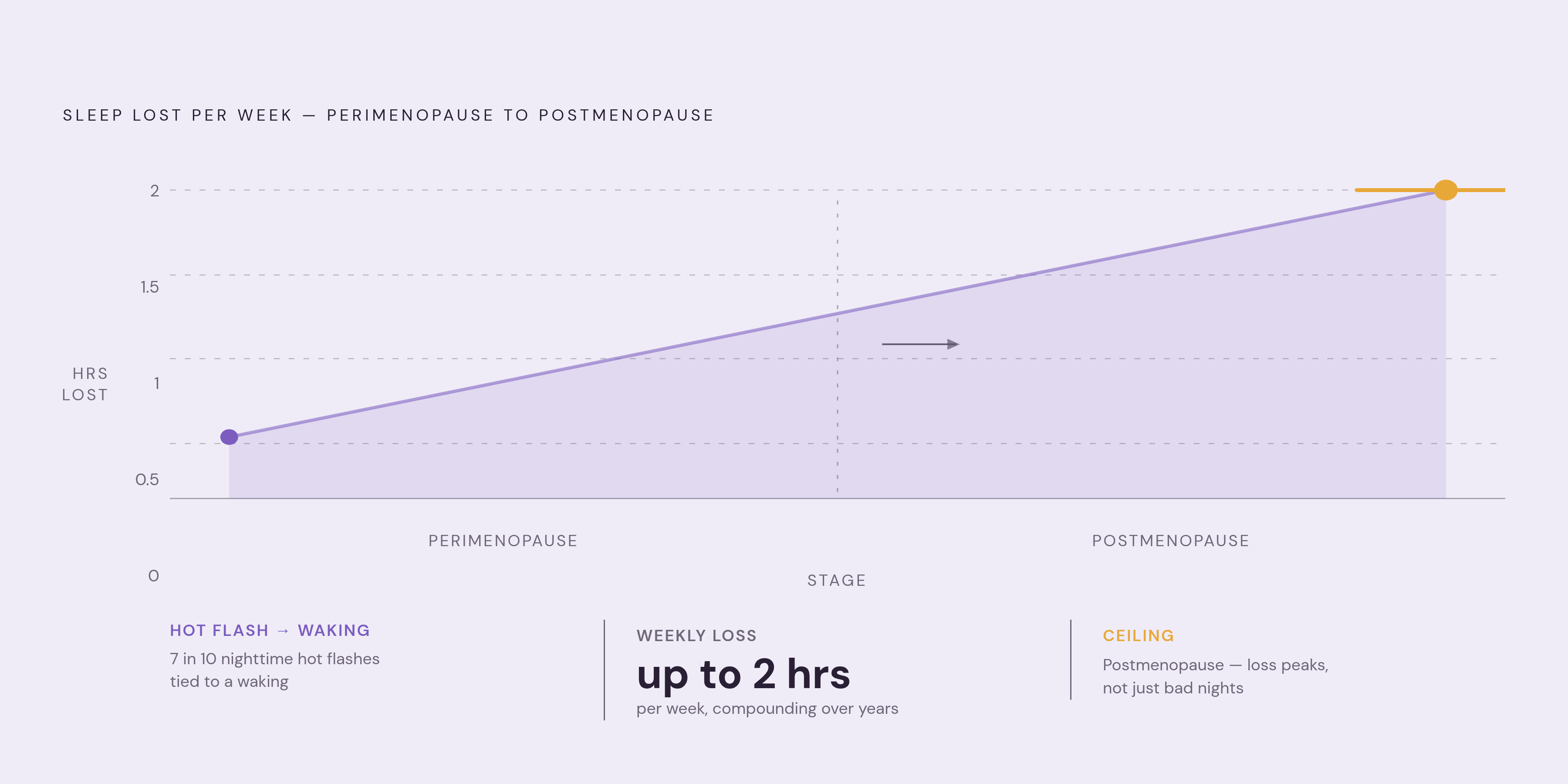
The most visible symptom of this instability is vasomotor: hot flashes and night sweats. Oura's own data shows that up to roughly seven in ten hot flashes are tied to a nighttime waking, and the company's reporting shows sleep loss accumulating progressively, up to two hours a week, as women move from perimenopause into postmenopause. That's a slow accumulation, not a single bad night. That's a slow bleed of sleep, week over week, for years.
Timing varies more than people expect. Perimenopause usually starts in the mid-40s, though it can begin as early as the mid-30s, and it lasts an average of four years, though the range runs from two to ten. Early on, in what's classified as Stage -2, progesterone is already declining while estrogen remains erratic. By late perimenopause, Stage -1, vasomotor symptoms typically intensify and FSH climbs further. None of this happens in isolation from the body's other systems. Heart rate shifts, skin temperature deviates, HRV changes, sleep architecture fragments, all of it a downstream consequence of the hormonal churn described above. These are exactly the signals a sensor can pick up. What a sensor cannot do, and this is the hinge the rest of this piece turns on, is tell you why those signals are happening.
What the Oura Ring's sensors physically measure
The device itself needs a fair, close look. The Oura Ring is measuring something real. It isn't inferring sleep purely from how much a wrist or finger moves around at night, the way early generations of fitness trackers did, but everything the ring reports as a sleep stage or a composite score is still an algorithm's interpretation of raw signal, not a direct readout of what's happening in the brain.
The hardware breaks into three categories. Photoplethysmography (PPG) sensors use infrared and red light to estimate blood oxygen saturation, and green plus infrared light to track heart rate, heart rate variability, and respiratory rate. A 3D accelerometer tracks movement. Temperature sensors track skin temperature, not as an absolute number but as a deviation from the wearer's own baseline. That baseline-relative approach matters quite a bit for perimenopause specifically, since absolute skin temperature varies so much between individuals that a single fixed threshold would be close to useless.
Oura measures from the finger, not the wrist, and that isn't a matter of comfort or aesthetics. Digital arteries sit closer to the skin's surface at the finger, producing a stronger pulsatile signal and a transmission geometry that's simply better suited to PPG sensing, which is also why clinical pulse oximeters clip onto a finger rather than strap around a wrist. It's a real physiological advantage, not a marketing flourish.
The current flagship at the time of its release was the Gen 4, which expanded to an 18-pathway Smart Sensing PPG platform (up from eight in earlier models) and added a 3D accelerometer, released in 2024 and tracking roughly 30 biometrics. The ring's headline outputs, Light Sleep, Deep Sleep, REM Sleep, and Awake Time, are all algorithmic derivations from those signal patterns. They are not EEG readings, and that distinction is going to matter enormously once the accuracy conversation starts. The Sleep Score runs on a 100-point scale, with anything from 85 to 100 considered optimal by Oura's own standard. The ring generates three composite scores: Sleep Score (sleep metrics), Readiness Score, and Activity Score. Oura recommends 2–4 weeks of consistent wear to establish a personal baseline (a design feature that matters for perimenopause tracking, where individual variation is high).
Oura's Accuracy: Validation Research and Findings That Cut Against the Marketing
So how good is it, really? The honest answer splits down the middle: strong on some measures, notably weaker on others, and the line between the two matters more in perimenopause than almost any other use case.
Start with what holds up well. A 2024 Japanese validation study (PMID 38382312) compared Oura's Gen 3 ring against ambulatory polysomnography, the clinical gold standard, and found overall sleep/wake detection accuracy of 91.7 to 91.8 percent, with no significant difference from PSG on total sleep time, time in bed, sleep onset latency, or time spent in light and deep sleep. Separately, a 2024 Oura-funded study out of Brigham and Women's Hospital found the ring outperformed both Fitbit and Apple Watch on four-stage sleep classification, by a meaningful margin on Cohen's kappa coefficients. A 2025 systematic review (PMC12602993) reinforced this, finding Oura comparable to PSG and actigraphy across commonly measured parameters, including individual sleep stages, with no statistically significant gap. That said, the same Japanese study found REM sleep was consistently underestimated, by a small margin of minutes on average.
Now, the finding that doesn't fit neatly into the pattern above. A 2025 study published in Scientific Reports found only modest accuracy across all sleep stages, a result sitting in real tension with Oura's own validation data. Methodology varies study to study, sample sizes differ, and lab conditions rarely map cleanly onto how someone sleeps at home with a partner, a dog, and a thermostat set wrong. Why? Methodology varies study to study, sample sizes differ, and lab conditions rarely map cleanly onto how someone sleeps at home with a partner, a dog, and a thermostat set wrong. None of that resolves the discrepancy outright, but it does explain why it exists.
Zooming out helps put the number in context. A 2025 multi-device comparison in SLEEP Advances (PMC12038347) tested six wrist-worn consumer devices against PSG and found Cohen's kappa coefficients ranging from 0.21 to 0.53 across the field. Against that backdrop, Oura is at or near the top of the consumer category, even allowing for the methodological noise baked into any cross-study comparison. A later industry review, Ubie's Doctor's Note (published May 2026, reviewed the following month), placed the Gen 4 at the top of the 2026 sleep tracker field, with accuracy tracking closely to polysomnography across multiple peer-reviewed studies, while still flagging that lab results don't always hold up identically at home.
Where does that leave a perimenopausal woman looking at her app each morning? Trust the aggregate numbers: total sleep time, how often she woke, the shape of the trend line across a month. Treat any single night's sleep stage breakdown as an estimate, not a measurement worth building a decision on.
|The four Oura metrics that are genuinely useful for tracking perimenopausal sleep
Given everything above, which numbers actually earn a perimenopausal woman's attention? Four stand out: skin temperature deviation, HRV, heart rate patterns, and sleep continuity. None of them work because the ring understands hormones. They work because hormonal volatility happens to express itself through exactly these signals.
Skin temperature deviation is the one Oura itself points to as most relevant for menopause tracking, and for good reason. It's measured against a personal baseline rather than an absolute number, which matters enormously given how much temperature regulation varies between individuals. Research on the menstrual cycle shows nocturnal skin temperature runs higher during the luteal phase, by a mean of roughly 0.30°C in one dataset. In perimenopause, that once-predictable rhythm falls apart, and the erratic pattern that replaces it is itself a signal worth watching, particularly since hot flash events tend to produce a detectable overnight temperature spike.
HRV works as a rough proxy for autonomic nervous system strain, which shifts as hormones fluctuate. Some sources describe a meaningful drop in HRV among women reporting mood changes or heightened anxiety, framed as a possible early marker of hormone imbalance. Because HRV gets logged every night rather than at one appointment months apart, a sustained shift across several weeks can appear in the data as a pattern that a single clinic visit would never catch.
Sleep continuity, the count and length of wake episodes overnight, holds up even where stage-by-stage classification gets shakier, and the 2024 Japanese study backs this specifically. For a woman whose nights are getting chopped up by night sweats, knowing when she wakes, how often, and for how long is genuinely actionable, especially paired with symptom tags. Oura built out 17 tags specific to perimenopause and menopause for exactly this reason. But the tagging only works if she actually uses it. Features like Resilience and Symptom Radar extend this kind of longitudinal tracking further. They read the downstream body's reaction to one.
Clinical significance of Oura's inability to distinguish causes in perimenopause
The honest limit is significant. Oura cannot tell a perimenopausal woman whether her disrupted sleep traces back to hormonal fluctuation, thyroid dysfunction, obstructive sleep apnea, anxiety, or some combination, because these conditions can produce nearly identical signatures in wearable data.
Both conditions disrupt metabolism, mood, and energy levels. The ring has no way to separate one from the other. Obstructive sleep apnea complicates things further. It has a distinct presentation in midlife women that clinicians in endocrine practice frequently misdiagnose, and fragmented sleep from apnea looks, on a graph, essentially identical to fragmented sleep caused by a hot flash.
The ring cannot measure estrogen, progesterone, FSH, or any other reproductive hormone directly, which means it cannot confirm a perimenopause diagnosis on its own. As one 2026 industry review put it bluntly, wearables alone can't diagnose why someone's sleeping poorly. Sleep apnea detection specifically was, for a stretch, a real gap in the Oura lineup, something competitors offered that Oura didn't. That changed once Gen 4 added apnea detection through a partnership with ResMed, closing what had been a genuine differentiator.
The cost of getting this wrong isn't abstract. The same 2025 Biote survey found that a substantial share of women prescribed medication for conditions like depression believed, after the fact, that the diagnosis had been incorrect, and the 2024 SWAN study tied persistent insomnia to a 71 percent increase in cardiovascular events. Put those two numbers side by side and the stakes of misattribution come into focus fast. A ring that flags a pattern without naming a cause isn't failing at its job. It's just being honest about where its job ends, and that, in a strange way, is what makes the next step worth taking.
Hormone testing as the explanation layer wearable data cannot provide on its own
So what fills the space the ring leaves open? Oura can flag that something in a woman's physiology is shifting overnight. It cannot say whether that shift comes from the perimenopausal transition, from a thyroid issue, or from something else entirely, and that's precisely the layer hormone testing is built to provide.
Hormone levels during perimenopause don't sit still long enough for a single blood draw to mean much. A single elevated reading isn't conclusive on its own, and treating it as though it were would repeat, in a different form, the same mistake wearable data risks: mistaking one snapshot for the whole picture. The value comes from watching hormone levels over time, the same way the ring's real value comes from watching HRV or skin temperature trend across weeks rather than staring at any single night in isolation. Neither tool, alone, tells the full story. Together, one measures the body's reaction and the other measures the cause behind it, which is roughly the pairing a woman moving through this transition actually needs.
Sources
- Oura vs. Competitors: The Most Accurate Sleep Rings of 2026 | Ubie Doctor's Note
- Oura Ring Review 2026: Expert Tested | Sleep Foundation
- Performance of wearable finger ring trackers for diagnostic sleep measurement in the clinical context | Scientific Reports
- Oura Ring for Women: Perimenopause Insights & Understanding
- Oura Ring for Women | Smart Rings for Menopausal Women | Bonafide
- Perimenopause Timeline: How Early Can It Start and What To Expect