Telehealth Perimenopause Services vs DTC Testing Services
Telehealth provides treatment while DTC testing reveals patterns over time.
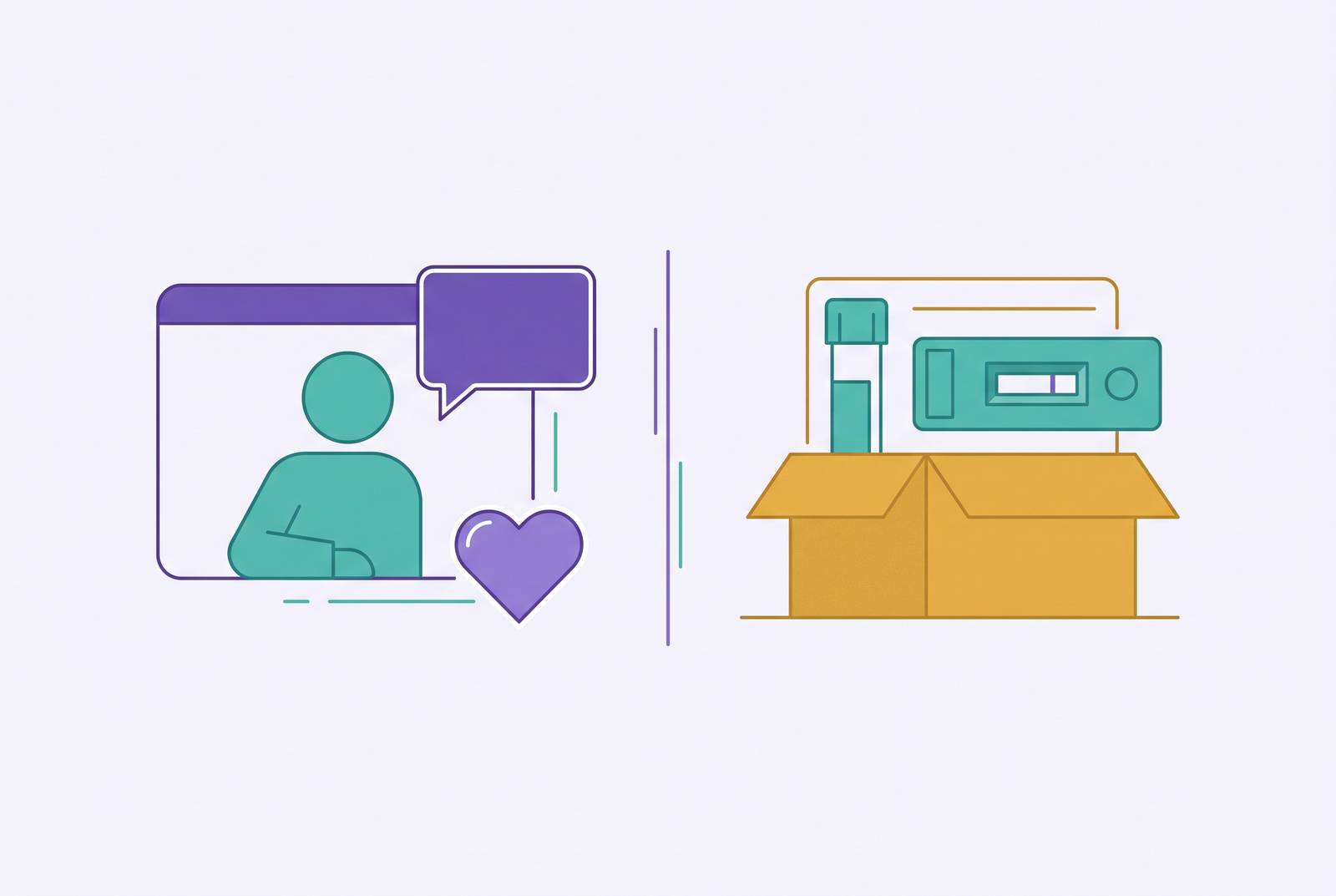
A woman can get perimenopause testing through direct-to-consumer (DTC) hormone testing services without a doctor's referral, but no single blood test can confirm perimenopause. Telehealth perimenopause services provide clinical care and prescriptions, while DTC testing provides interpreted hormone data that can be tracked over time. The choice depends on whether a woman needs help understanding her symptoms, treatment for them, or both in sequence.
Why perimenopause sits in a diagnostic no-man's-land that created demand for both service types
Cleveland Clinic describes a transition in which the ovaries begin producing less estrogen and progesterone, with hormone levels fluctuating unpredictably. Symptoms can therefore come and go or change intensity from month to month. Irregular periods may come with sleep disruption, mood changes, hot flashes, cognitive changes or joint pain. What looks like a collection of separate problems may belong to the same hormonal transition.
Yet a shared explanation is not the only possible explanation. Thyroid dysfunction, depression and anxiety overlap with perimenopause, and those conditions can also coexist. Mood symptoms are especially difficult to place because anxiety can be part of the transition without every episode of anxiety being hormonal. Diagnosis requires deciding what a familiar symptom means within a changing menstrual, hormonal and medical history.
FSH levels can move into and out of the “menopausal” range between draws, so a snapshot may suggest more certainty than it deserves. At the same time, a symptom description without a timeline can leave a clinician treating each complaint in isolation. Women need both a way to make the pattern legible and a way to obtain care. Those are related needs, but they are not the same job.
What telehealth perimenopause services actually deliver
Telehealth perimenopause services are built around access to a licensed practitioner who can diagnose, prescribe and adjust treatment without an in-person visit. The practitioner may be an OB/GYN, NP or functional medicine physician, depending on the service. The main output is a care plan. For a woman whose symptoms are clear and who wants treatment, that distinction is a strength. It connects recognition of the problem with someone able to act on it.
Different services organize that access differently. Parsley Health uses a broad blood panel covering thyroid, kidney, metabolic, stress and hormone markers as an entry point, followed by a clinician's explanation and personalized plan. Maven Clinic provides menopause-trained OB/GYNs, NPs, therapists, pelvic floor physical therapists and nutritionists through employer and health plan benefits.
The market has also expanded through cash-pay entrants. Noom launched an HRT program in late February 2025, and Hims & Hers planned at-home testing to enable perimenopause and menopause care. Health experts have cautioned that profit incentives in this segment may influence prescribing behavior, a reason to distinguish access from the quality of a prescribing decision. Still, virtual care addresses a real shortage of menopause specialists by removing geographic and scheduling barriers. In most cases, women do not need hormone testing before starting hormone therapy and it is not recommended, while HRT dosing is guided by symptoms.
What DTC testing delivers without a doctor's referral
With DTC testing, a woman can get hormone testing without first getting a GP referral or going to a separate clinical appointment. With the clinician-reviewed venous-blood model, a woman gets a panel, laboratory results and an explanation of what those results mean for her. Panels typically include estradiol, FSH and progesterone, with AMH and other markers potentially included. The output is information about hormonal status. Buying that information directly changes the route to testing, but it does not make a blood result a standalone diagnosis.
The details of the panel and collection method matter. FSH testing on day three of the menstrual cycle provides the most consistent results when periods still occur regularly. AMH remains relatively stable throughout the menstrual cycle compared with FSH and estradiol, making timing less critical and results more consistently comparable across draws. A well-designed panel using venous blood can provide accurate laboratory measurements. That should be distinguished from lower-quality at-home saliva kits, whose sampling methods are less standardized.
Testing over months or years can reveal a directional pattern that hormone volatility obscures in one draw. Intermission Health pairs a curated blood panel with clinician review and personalized analysis designed to be tracked over time. It illustrates the longitudinal role of DTC testing without changing the limits of what a hormone panel can establish. Diagnostic clarity here means a better-informed understanding of a trajectory.
Where telehealth falls short, and why data fills the gap
A symptom-first service works most directly when the presentation is straightforward. Its limits become more important when several conditions could explain the same complaints or when a woman wants to understand changes that remain ambiguous. A menopause-only model may not fit someone with comorbidities that need broader assessment. The care model needs enough scope and evidence to distinguish overlapping explanations.
Thyroid disease offers a concrete example of that problem. The European Menopause and Andropause Society's 2024 position statement advises a low threshold of suspicion for thyroid disease when sweating, mood changes, anxiety, low libido and menstrual irregularity appear, a familiar perimenopausal symptom cluster. A symptom report alone may not settle which condition is contributing, and the two may coexist. Hormonal data can enrich the assessment, but it does not remove the need to consider thyroid disease on its own terms.
Longitudinal data is useful in this setting because it adds a time dimension to the clinical picture. A tracked hormonal trajectory gives the clinician more context than an isolated FSH result that happens to be high or normal on the day. Unexpected bleeding, vaginal discharge or a palpable breast change requires in-person assessment, and virtual visits cannot replace regular clinical examination or in-depth screening. The distinction is between an information gap, which testing may help address, and an examination gap, which it cannot.
Where DTC testing falls short, and why clinical access fills the gap
The same scrutiny applies to testing services. A panel may provide useful information without identifying the cause of every symptom or establishing what treatment is appropriate. Most DTC hormone kits give only limited information and cannot rule out other causes. A result that fits what a woman has been feeling may be validating, but validation is not a treatment decision. Testing reaches its ceiling when the next question is what to prescribe, adjust or investigate clinically.
NICE menopause guidance places that limit in a practical context. In women over 45, diagnosis is usually based on symptoms and menstrual history. A measurement must answer a defined question within a clinical assessment. Repeating a test adds context over time, but a series of numbers still needs judgment about its significance.
That makes clinician review a core criterion when comparing testing services. In Intermission Health's model, review is embedded in the testing process, so results arrive with expert interpretation. Interpretation can help prevent a single FSH result from being mistaken for a conclusive diagnosis. It still does not give a testing panel the ability to prescribe HRT, a non-hormonal sleep aid or vaginal estrogen. For those needs, the data can prepare a conversation, but a prescribing clinician must carry it forward.
How the misdiagnosis pattern shapes which tool a woman needs first
For some women, this decision begins after an explanation has already been offered and has failed to account for their experience. Symptoms may have been attributed to anxiety, depression or stress without sufficient attention to hormonal change. In that situation, immediate access to another prescription may not answer the central concern. The first need may be evidence that a hormonal explanation deserves consideration. That is a different starting point from recognizing clear perimenopausal symptoms and seeking treatment for them.
Seven of the eight items on the PHQ-8 depression scale may be caused by perimenopause or menopause. Among these are sleep disruption, fatigue, appetite changes, concentration difficulties and mood disturbance. A psychiatric explanation should leave room for a hormonal contribution.
A symptom timeline, menstrual history and interpreted hormone data can make a subsequent consultation more specific. Together, they give a woman something concrete with which to ask whether the original explanation accounts for the course of her symptoms. Shame and stigma can make that conversation difficult, while the privacy of at-home testing may lower the barrier to beginning an investigation. Privacy, however, is separate from sample quality, and an at-home kit should not be confused with a venous draw at a laboratory. Longitudinal testing can help a woman speak up for herself with more context, but she should not use a result she prefers to make her own diagnosis.
As HRT guidance has changed over decades, healthcare professionals have also been left with gaps in what they know. An informed woman may be better positioned to challenge a generic referral or dismissal, but she should not have to resolve the entire diagnostic problem herself. A woman then needs a clinician to weigh the evidence and decide what to do next. The sequence matters because evidence and intervention address different parts of the same unresolved experience.
Matching the right tool to the right moment in the transition
The practical choice starts with identifying the unresolved need. Early in the transition, when symptoms are new, ambiguous or have been dismissed, clinician-reviewed DTC testing can provide baseline information for later clinical conversations. That information is most useful when considered with symptoms and menstrual history. A woman whose symptoms are clear and straightforward and who wants hormone therapy may go straight to telehealth care.
Overlapping conditions change the calculation. A woman may need a broader clinical assessment that draws on longitudinal data if her thyroid could be involved, her mood symptoms were put down to anxiety or depression, or she has been given explanations that conflict. In that setting, the purpose of testing is to reduce ambiguity before a treatment plan is settled. The relevant service criteria are the sampling method, panel design, clinician interpretation and ability to track results. For telehealth, the range of care the service offers needs to fit the woman's needs.
Time also changes which tool is useful. UPMC describes a transition that typically begins in the mid-40s and can last up to eight years, so needs in year one may differ substantially from needs in year four. For the longitudinal testing role, Intermission Health offers a curated panel, clinician review and personalized analysis designed to accumulate into a readable trajectory. Telehealth or traditional clinical care can then act on that information where action is needed. The strongest comparison is therefore not a universal ranking of services, but a sequence in which testing helps clarify the picture and clinical care turns that understanding into an appropriate plan.