Why Serial Testing Beats Single Snapshots for Perimenopause Hormone Monitoring
Tracking hormone patterns over months reveals fluctuations that single tests cannot capture.
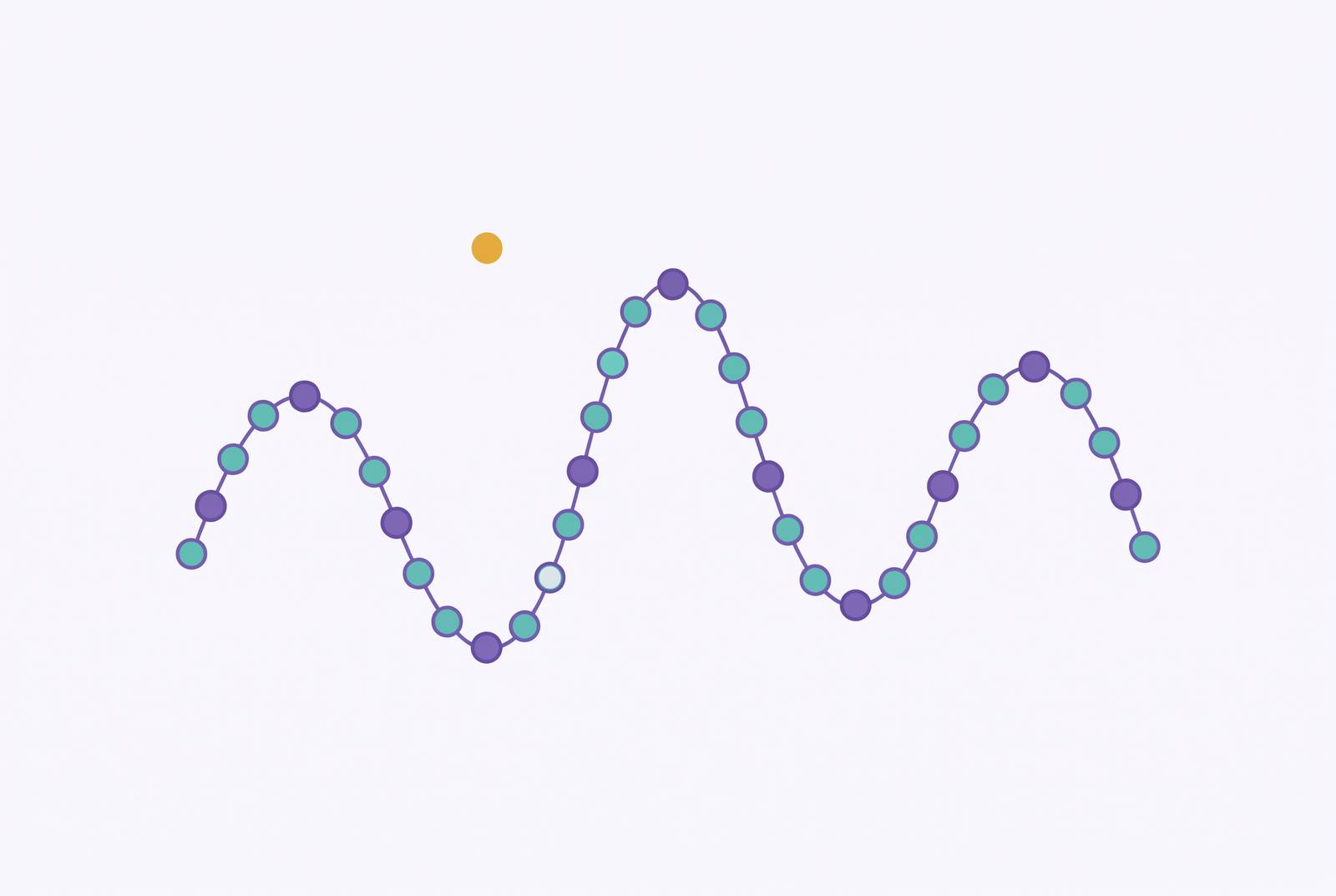
Longitudinal perimenopause hormone tracking measures hormones over time to show changes that a single test cannot capture. Because hormones fluctuate rather than decline steadily, the useful signal is their pattern over time, interpreted with symptoms and clinical history. Serial testing can make that pattern clearer, but a clinician must still make the diagnosis.
Why perimenopausal hormones don't decline in a straight line
The hypothalamic-pituitary-ovarian axis coordinates follicular development, ovulation, and estrogen and progesterone production. As ovarian reserve declines, follicular responsiveness becomes irregular, and this feedback loop loses coherence. These changes start years before the final menstrual period. As this feedback loop breaks down, hormone production becomes harder to predict before it stays low, so a smooth downward slope gives the wrong picture of early perimenopause.
The pituitary initially compensates by producing extra follicle-stimulating hormone, or FSH. That compensation can overstimulate remaining follicles, producing unusually high estradiol in some cycles. In another cycle, a follicle may fail to mature and estradiol may crash. Both can happen in the transition as the ovarian response grows more irregular.
FSH can also rise abruptly into a postmenopausal range and then return to values typical of young fertile women, sometimes while ovulatory cycles continue. What, then, does an isolated high reading establish? It describes pituitary activity at that moment, but cannot establish how persistently the pattern is occurring. The four markers E3G, LH, PdG, and FSH each describe a different part of this process. Their clinical value depends on how they change in relation to one another.
What the standard staging system can and cannot tell you
The STRAW+10 staging system, the accepted way to classify reproductive aging, is based mainly on bleeding patterns. That reliance makes it a pragmatic research framework rather than a complete account of an individual’s hormonal activity. Bleeding patterns provide a way to organize the transition. They do not reveal every endocrine change within it, and they can become unreliable while symptoms persist.
This distinction helps explain why apparently contradictory findings can coexist. In early perimenopause, FSH may be elevated while estradiol is also elevated, creating genuine uncertainty if a clinician tries to infer stage from one draw. Late perimenopause is defined by cycle gaps of a threshold length, but the final menstrual period can only be identified retrospectively after 12 consecutive months without a period. Staging therefore has a built-in lag behind the biology. It can describe where someone has arrived more confidently than it can resolve every change as it happens.
The framework encounters a sharper limit when bleeding is no longer a reliable marker, including with hormonal contraception or after ablation. The Personalized Lifestyle Medicine Institute’s September 2026 clinician session identifies this limitation as a reason to consider longitudinal hormone monitoring. AMH offers a different view because it remains relatively stable across the menstrual cycle and more directly reflects ovarian reserve, but that does not mean it stays stable across years of transition. No single marker resolves the whole staging problem. The testing method must fit the question left unanswered by the bleeding history.
Why a single hormone draw produces a structurally misleading result
A single draw samples one point on a jagged line. The result may be analytically accurate yet structurally misleading if it is treated as a description of the whole transition. Depending on where the sample lands, it can suggest normal function, disease, or the wrong reproductive stage. Precision at one moment is not the same as representativeness over time. The missing information is timing, trajectory, and cycle-to-cycle variability.
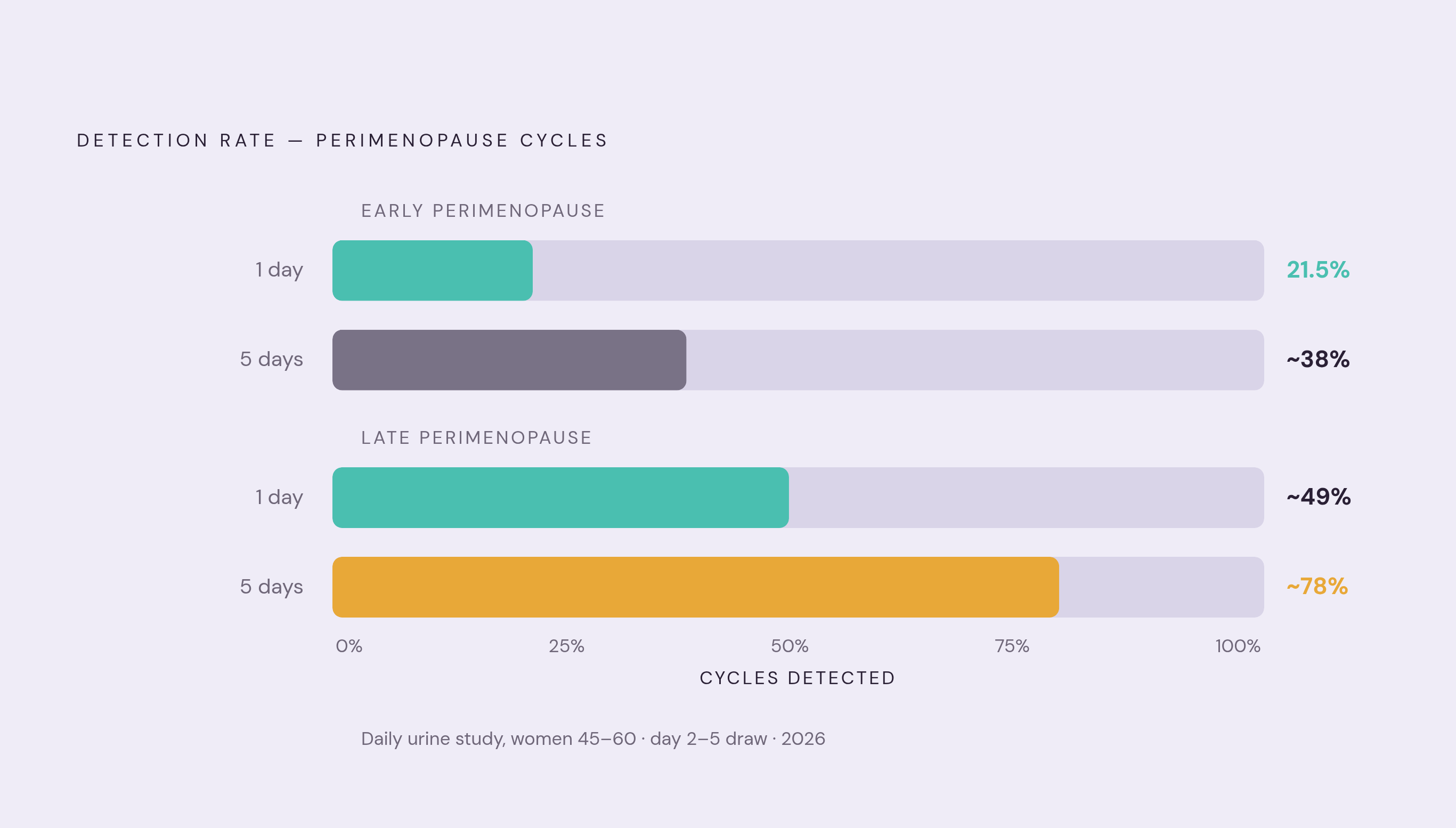
The SWAN study found substantial hormonal variability both between women and within the same woman, with FSH changing dramatically over several months. A 2026 study of women aged 45–60 collecting first morning urine daily illustrates the testing consequence of that variability. A single test on the recommended cycle day 2–5 was positive in only 21.5% of early perimenopause cycles. Testing for five consecutive days picked up far more cases of late perimenopause but still missed a large share of early cases. Together, these findings show why a negative snapshot cannot reliably settle a question about an intermittent hormonal pattern.
The same problem affects progesterone testing when the sampling day is only an indirect estimate of when ovulation occurs. A fixed calendar day can miss the biological event it is meant to assess. Research in the Journal of Clinical Endocrinology & Metabolism found that hormone patterns over time predicted symptom severity and treatment response better than individual measurements. Estradiol withdrawal and downward swings, rather than simply a low average estradiol level, were associated with vasomotor symptom onset.
There is also a mismatch between a familiar test and its intended purpose. The conventional day-3 FSH test was designed to assess ovarian reserve for fertility purposes and has not been validated as a perimenopause diagnostic tool. Yet it is frequently the only test ordered.
The downstream consequences when the hormonal driver goes undetected
When fluctuating hormones go unrecognized, symptoms can be assigned to a primary psychiatric disorder without the transition receiving adequate consideration. A clinical explanation of depression or anxiety may be incomplete when it leaves the hormonal contribution unexplored. That distinction changes what a clinician needs to understand about the timing and character of symptoms.
Reduced progesterone exposure provides one example of a mechanism that a snapshot may conceal. Declining PdG patterns can reflect fewer ovulatory cycles and less progesterone exposure, which may contribute to disrupted sleep, mood changes, and altered GABAergic signaling. These effects can accumulate over months. Hormonal changes also affect bone remodeling, so their effects go beyond symptoms that are felt right away. Thyroid dysfunction remains an important differential because hyperthyroidism and perimenopause can produce nearly indistinguishable heat intolerance, sleep disruption, mood changes, palpitations, and menstrual irregularities.
NIMH-funded research at the University of North Carolina found a 2–4-fold increase in major depression risk during the menopause transition. Perimenopausal depression may feature irritability, anger, and paranoia more prominently than sadness, increasing the risk that it is mistaken for a primary psychiatric disorder. Zhang et al. (2025) documented a rising disability-adjusted life year rate for anxiety disorders among perimenopausal women and projected further increases, attributing much of the burden to hormonal disruption of regulatory feedback mechanisms. Recognizing this possibility requires a system prepared to investigate it.
Why the healthcare system is structurally unlikely to catch this on its own
Menopause training leaves a gap between the complexity of the biology and the tools available in routine care. Many OB-GYN residency programs have no curriculum devoted to menopause, while primary care physicians may have little or no formal training in how to recognize, diagnose, or treat it. Primary care is often the first contact. A clinician may therefore encounter a complex hormonal presentation without having received dedicated preparation for interpreting it.
Brief appointments and the convention of ordering a single FSH or estradiol draw reinforce that limitation. Symptoms may be treated with antidepressants, anxiolytics, or sleep aids without investigating whether hormonal fluctuations help explain the presentation. This limitation is structural. The appointment format and available testing convention favor a momentary answer when understanding hormonal fluctuations requires observations over time.
RegenCen’s national survey of women ages 35 and older, conducted between June and August 2026 and released in September 2026, found that nearly two in three reported feeling dismissed when raising perimenopause or menopause symptoms. Nearly half said it had happened more than once. These reports show what patients went through, but they do not prove what caused each encounter. Huibregtse et al. (2026) identified a related gap in research, namely the absence of standardized, prospective reproductive staging methods. The difficulty of following the transition as it unfolds thus affects both clinical practice and the evidence available to guide it.
What serial testing actually reveals that a snapshot cannot
Repeated measurements allow a clinician to ask how the parts of a cycle fit together. E3G captures estrogen activity and follicular recruitment, while LH shows whether ovulatory surges are occurring. PdG helps reveal whether ovulation was followed by adequate progesterone production, and FSH reflects pituitary compensation. The sequence is the useful unit of interpretation. It connects an estrogen rise, an ovulatory signal, and the subsequent progesterone response rather than treating each as an independent pass-or-fail result.
The PLMI session shows this difference with two consecutive cycles mapped each day. Ovulation shifted from day 16 to day 22, while an estrogen surge was preserved and the luteal response was blunted. A fixed day-21 draw would have missed that picture entirely. The serial record distinguishes a change in timing from a change in the hormonal response after ovulation. Without that sequence, a clinician has much less to go on when deciding what a single progesterone value means.
Tracking over more time makes it easier to tell early and late transition patterns apart. Early perimenopause may show intermittent E3G peaks, variable LH surges, shorter or lower PdG rises, and intermittent early-cycle FSH elevations. This pattern may contribute to irregular bleeding, breast tenderness, migraines, mood fluctuations, and sleep disruption. Late perimenopause looks different over repeated observations. E3G trends lower despite possible intermittent surges, LH may have a higher baseline with fewer defined ovulatory surges, PdG remains low across many cycles, and FSH is consistently elevated. When irregular or prolonged bleeding persists in this setting, endometrial health may need a closer look.
Serial data can also help clinicians assess hormone replacement therapy by showing patterns across cycles after treatment. The PLMI session addresses how longitudinal monitoring can support assessment of HRT effectiveness and treatment adjustments. New evidence also links elevated FSH to a greater burden of vasomotor symptoms, which suggests that changes in FSH over time may tell clinicians more than estradiol alone. These applications still require interpretation in context. A link between findings or a change in a laboratory value is not enough on its own to decide on treatment.
How to track hormone levels over time during perimenopause at home
For someone considering serial monitoring, the approach should suit what they need to learn about their hormone patterns. A useful approach includes the relevant markers, a repeatable sampling interval, and clinician interpretation. A curated blood panel can follow reproductive hormones together, including FSH, estradiol, and, where possible, LH and progesterone markers. At-home urine monitoring instead follows markers such as E3G and PdG together with LH and FSH. Serum, urine, and saliva measure different things, so the sample must be suited to the question being asked.
Taking repeated draws in the same general timing window helps show changes over time, while daily mapping can show shifts in timing within a cycle, as in the two-cycle example above. These approaches answer different questions. Repeating a fixed-window measurement is not equivalent to mapping an ovulatory sequence, and the daily-urine study shows that even five consecutive days can miss early cases. The notes do not establish one universal testing interval for every stage or purpose.
Clinician review is essential to make these distinctions useful. The PLMI session emphasizes that symptoms still make the diagnosis, while monitoring helps explain the mechanism underneath them. Hormone patterns must therefore be considered with symptoms, bleeding history, stage, and individual risk. Women with irregular cycles, disrupted sleep, mood changes, or cognitive fog whose standard workup was “normal” are particularly relevant candidates for considering whether a longer record would clarify the picture.
Access to that record can also strengthen self-advocacy in clinical care. Instead of presenting symptoms separately from laboratory results, a woman can bring a pattern for discussion with her provider. She and her provider can explore whether changes in timing and hormone exposure help explain what she is experiencing. That is a more specific clinical conversation than asking whether one hormone number is normal.
Sources
- Considerations and practical recommendations for identifying perimenopause in longitudinal research - PMC
- Global, regional, and national burden of anxiety disorders during the perimenopause (1990–2021) and projections to 2035
- Longitudinal Biomarker Assessment in Reproductive Aging: Discover Risks by Interpreting Multi-Hormone Patterns Over Time - Personalized Lifestyle Medicine Institute
- Advancing Hormone Assessment in Perimenopause and Menopause: Moving Beyond Symptoms to Longitudinal Monitoring - Personalized Lifestyle Medicine Institute
- Steroid Hormone Secretion Over the Course of the Perimenopause: Findings From the Swiss Perimenopause Study
- Estrogen Variability and Irritability During the Menopause Transition