How Often to Retest Hormones During Perimenopause
Repeated blood tests are necessary to track hormonal volatility, not diagnose perimenopause.
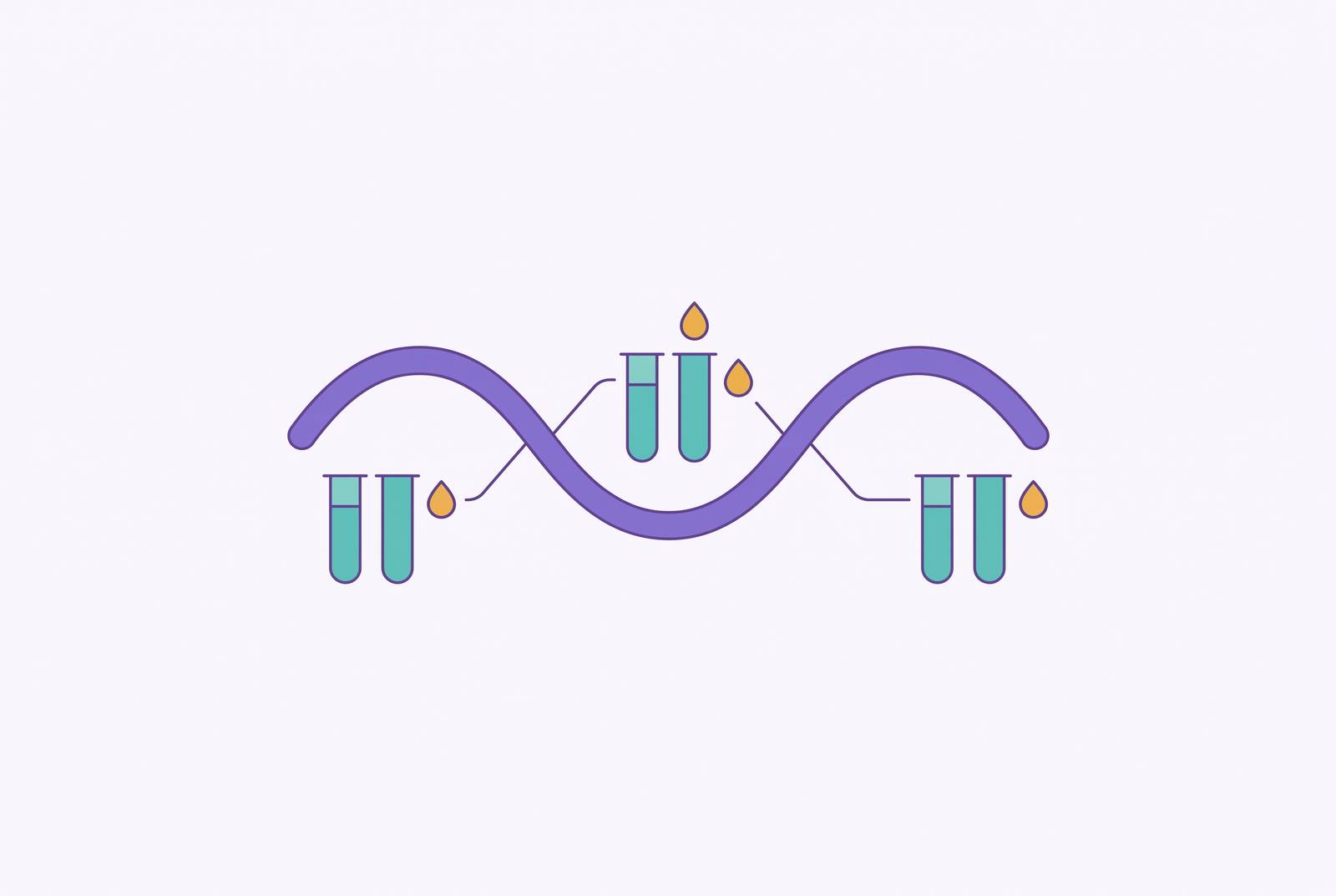
FSH and estradiol do not move in one direction during perimenopause. They swing, sometimes sharply, from one cycle to the next. A single blood draw tells a woman what her hormones were doing on that particular day and very little about where she stands in the broader transition. Longitudinal data on estradiol bears this out: levels documented across the transition show not a steady decline but transient increases scattered among the drops, so a woman can record a relatively high estrogen reading in one cycle and a substantially lower one in the next. That pattern alone explains why a single test, drawn once and interpreted on its own, is a poor tool for understanding a process defined by its instability.
The unpredictability runs deeper than the blood panel. Clinical thinking on the transition, including work from physicians who study it closely, now holds that neurological symptoms (fatigue, brain fog, rising anxiety) can appear before menstrual cycles become noticeably irregular. If that sequence holds, the hormonal transition may already be underway biologically before it becomes visible on conventional testing, the irregular bleeding and the elevated FSH that define it by convention. A woman could be symptomatic for months before any test would flag her as "in perimenopause" by conventional criteria, and a clinician relying on a single test drawn too early will miss the process in motion.
That instability is not evenly distributed across the whole transition. Serial testing over time is more useful for disambiguation than a single panel: a pattern of rising FSH alongside estradiol volatility is a different picture from stable reproductive hormones with abnormal thyroid markers, and distinguishing the two requires more than one data point. The volatility in FSH and estradiol is not constant across those stages, it intensifies in the middle and begins to settle as a woman approaches her final period. That structure, stable-to-volatile-to-settling, is what makes the question of retesting frequency answerable at all, and it is the frame the rest of this piece builds on.
What each perimenopause hormone measures
Not every hormone in a perimenopause panel behaves the way FSH and estradiol do. AMH stands out as the comparatively steady marker in the group: hormone guidance published in 2026 by Levels notes that AMH levels stay relatively stable over 6 to 12 months, so frequent retesting is not necessary unless symptoms shift significantly. AMH tracks ovarian reserve over time rather than capturing a single moment the way FSH does.
FSH sits at the opposite end of that spectrum. Because it can rise and fall within the same woman across consecutive cycles, a single elevated or normal reading carries limited diagnostic weight on its own, a point guideline bodies have made explicit and one this piece returns to in the next section. Progesterone, testosterone, LH, and DHEA-S round out a comprehensive panel, and each contributes distinct information about reproductive and metabolic function, but their clinical weight is not fixed. It shifts depending on the question being asked: whether the concern is ovulatory function, androgen-related symptoms, or something else entirely.
Thyroid function, measured through TSH, belongs in an early workup for a different reason. It is not a perimenopause-specific marker, it is a baseline check, and it earns its place because thyroid dysfunction produces a strikingly similar symptom set: fatigue, brain fog, weight changes, palpitations, mood shifts. Misattributing those symptoms to perimenopause when a thyroid disorder is the actual driver is a documented clinical risk, one the later section on misdiagnosis returns to in more detail.
How often a woman should retest is not a single question with a single answer." is not a single question with a single answer. It depends entirely on which marker is in question and why. Retesting AMH annually is reasonable given its relative stability, while FSH may need to be checked quarterly during a stretch of rapid symptom change. Treating a perimenopause panel as one undifferentiated block of numbers, all deserving the same retesting cadence, misreads the biology this section has just laid out.
Official guidelines on testing and the gap they leave for women in the transition
The major clinical guidelines take a fairly narrow view of when hormone testing is useful, and that narrowness reflects a specific clinical logic rather than an oversight. The 2025 ESE Clinical Practice Guideline, endorsed jointly by the Endocrine Society, the European Menopause and Andropause Society, and the British Menopause Society, states that for women over 45 presenting with typical symptoms, biochemical testing is not required to diagnose or manage perimenopause. For a woman whose age and symptom profile already point clearly toward the transition, a blood panel adds little to what a careful clinical history already shows.
The same guideline, though, undercuts the idea that a single test could substitute for that clinical judgment even if a clinician wanted it to. It notes that a normal FSH reading in a fertile woman does not rule out perimenopause, which is itself a quiet argument against leaning on any one test result as definitive. If a normal FSH cannot exclude the diagnosis, an abnormal one, drawn once, cannot confirm a trajectory either.
That is where the guidance runs into its limits. The guidelines were built to answer a diagnostic question, whether a given woman's symptoms are consistent with perimenopause, not a monitoring question: how is a particular woman's hormonal picture evolving, and is whatever she is doing about it actually working? Those are different questions, and a framework designed for the first does not automatically serve the second. The gap matters most for women who have no menstrual cycle to use as a reference point at all, including those on hormonal contraceptives or those who have had surgery affecting their cycle. For them, biochemical data becomes a more necessary anchor, not a less necessary one, because the usual bleeding-pattern clues simply are not available.
The IMS 2026 Recommendations take a position better suited to that monitoring question. Rather than treating FSH, estradiol, and AMH as one-shot diagnostic tools, the recommendations frame them as supportive criteria meant to be tracked across multiple draws to see where a woman's transition trajectory is heading. That shift, from a single confirmatory result toward a pattern built from repeated measurements, is the bridge into the stage-by-stage approach that follows.
Retesting intervals across the stages of transition
Once testing is understood as trend-tracking rather than one-time confirmation, the practical question becomes how often to draw blood at each point along the transition, and the honest answer is that it depends on how stable or volatile the picture currently is, not on a fixed calendar.
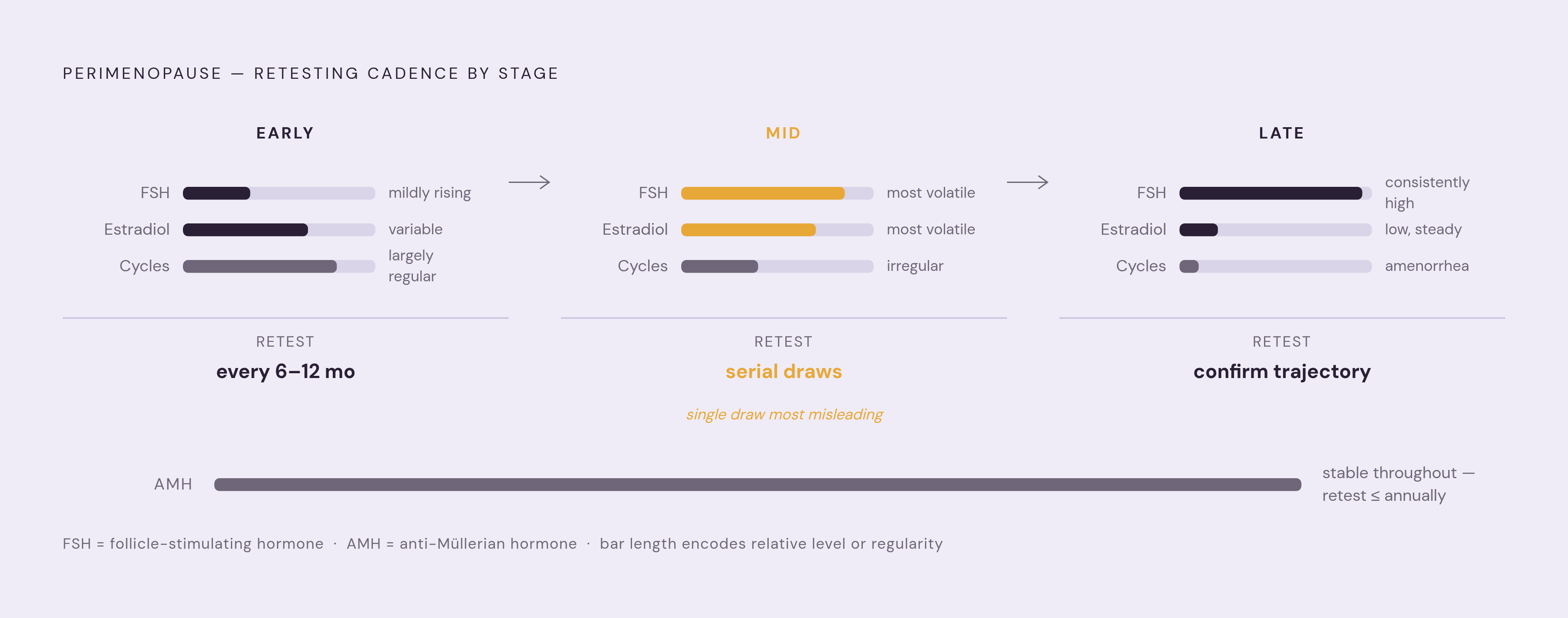
In the early transition, cycles are still largely regular and symptoms are just beginning to appear. Hormones are starting to fluctuate, but they have not yet entered the erratic swings that mark the middle of the process. A baseline panel at this stage has real value: it gives a woman and her clinician a personal reference point to compare against later, before the volatility intensifies. Retesting at 6 to 12 months is a reasonable rhythm here, provided symptoms are not shifting sharply in the meantime.
Mid-transition looks different. Cycles become irregular, symptoms are active and often intensifying, and this is the period in which FSH and estradiol are least cooperative. A single draw here is the hardest of any stage to interpret and the most likely to mislead a woman into thinking either too little or too much is happening. The IMS 2026 approach favors serial testing in this window: repeat draws at intervals a clinician sets, read together as a trend rather than treated as isolated, stand-alone values.
Late transition settles into a different pattern again. Amenorrhea stretches out, FSH tends to climb toward consistently elevated levels, and estradiol settles toward a lower, steadier floor. Testing at this point is less about catching sudden volatility, because there is less of it, and more about confirming where a woman's trajectory has landed and supporting whatever treatment decisions follow from that.
AMH's relative stability holds across all three stages. It remains useful as an ovarian reserve indicator throughout the transition and does not need retesting more than annually, or when symptoms change significantly, given that it holds steady over 6 to 12 months regardless of which stage a woman is in.
One more variable cuts across all of this staging: sudden symptom acceleration. If sleep, mood, or cognitive symptoms worsen abruptly, that acceleration is itself a clinical signal, one that can justify an unscheduled retest even inside an otherwise stable monitoring window, because the underlying hormonal picture may have moved faster than the calendar assumed it would. The purpose of a test, not just the stage a woman is in, determines which marker matters: IMS 2026 is explicit that FSH values are not useful for monitoring hormone absorption from HRT, a point the next section develops further. Stage sets the baseline rhythm. Purpose decides which number is worth reading.
Testing frequency and timing after starting hormone therapy
Starting hormone therapy changes what testing needs to answer. Before treatment, the goal is to understand where a woman sits in a naturally shifting process. After treatment begins, the goal narrows to something more answerable: is the dose she is taking producing the hormone levels it is supposed to produce?
The British Menopause Society lays out a structured schedule built around that question. It recommends a baseline panel, covering hormones, thyroid function, lipids, and liver function, before starting HRT at all. That is followed by a draw at 6 to 8 weeks after starting or adjusting a dose, checking estradiol and FSH, then a fuller panel at 3 to 6 months, and annual review after that.
FSH is not a reliable marker for monitoring how well the body is absorbing hormone therapy. The marker that matters for that purpose is estradiol, which reflects the actual amount of hormone reaching circulation from the treatment itself. A clinician checking FSH to see whether a patch or gel dose is working is checking the wrong number.
Blood work is only half of how treatment response gets assessed. Standardized symptom tools, sleep quality scales, mood scales, menopause-specific quality-of-life questionnaires, run alongside the panels, with a baseline established before HRT starts and reassessment at 6 to 12 weeks and at each regular follow-up after that. A woman's reported sleep and mood changes are tracked data points in this schedule, not anecdotal asides to it.
The regulatory backdrop shifted recently, and it is part of the conversation around starting or adjusting HRT, even though it does not change this monitoring schedule. In February 2026, the FDA removed boxed-warning language concerning cardiovascular disease, breast cancer, and probable dementia from six hormone therapy products: Bijuva, Divigel, Cenestin, Enjuvia, Prometrium, and Estring. Separately, the boxed warning for uterine cancer remains in place on estrogen-only systemic products, and compounded "bioidentical" hormone preparations remain outside FDA approval altogether, distinctions that matter to how a monitoring conversation gets framed even though they sit outside the testing schedule itself.
This schedule applies to women actively on hormone therapy. It is a different population, with a different question to answer, than the stage-based tracking described in the previous section, and the two should not be collapsed into one set of instructions.
Why perimenopause symptoms are routinely misattributed
Fatigue, disrupted sleep, palpitations, weight changes, cognitive fog, irritability, and mood swings can each come from reproductive aging, from thyroid disease, from a psychiatric condition, or from some combination of all three happening at once. A single test, drawn once, cannot sort a symptom list that broad into its correct cause, and that limitation has real consequences for how women get diagnosed and treated.
Hashimoto's thyroiditis is the clearest case study. It shares a strikingly similar symptom profile with perimenopause: fatigue, brain fog, weight gain, mood changes all appear on both lists. The two conditions are told apart through different diagnostic routes: perimenopause is assessed largely through symptom pattern and menstrual history, while Hashimoto's requires thyroid function tests and antibody screening.
The scale of misattribution is measurable. The 2025 Bonafide State of Menopause survey found that roughly a quarter of women between 40 and 49 had a healthcare provider incorrectly attribute their perimenopause symptoms to anxiety. That number points to a pattern.
Part of the reason that happens traces back to how depression itself gets screened. Seven of the eight conditions listed on the PHQ-8 depression scale, the tool widely used to assess depressive symptoms, can also be caused by perimenopause or menopause rather than by clinical depression. A woman moving through hormonal volatility can score as depressed on a standard screening tool even when the underlying driver is entirely hormonal, which puts her at genuine risk of a psychiatric diagnosis and treatment path aimed at the wrong target.
This is where serial testing earns its keep as something more than a monitoring convenience. It becomes the tool that actually disambiguates. A pattern of rising FSH paired with volatile estradiol tells a different story than stable reproductive hormones sitting alongside abnormal thyroid markers, and a clinician cannot tell those two stories apart from one blood draw. It takes more than one data point to know which condition is actually driving the symptoms, and that is precisely the argument the earlier sections on hormone volatility and marker stability were building toward. A woman walking into an appointment with a record of values over time is in a far stronger position to get the right explanation attached to what she is experiencing.
The structural barriers that make appropriate retesting harder to access than it should be
Everything in the preceding sections points toward the same conclusion: serial testing, interpreted as a trend and matched to the right marker and the right stage, is what the evidence actually supports. Getting that kind of testing in practice is a different matter than knowing it is the right approach.
Insurers and clinicians look to guidelines built around diagnosis, not tracking, to decide what counts as "necessary" testing. If the 2025 ESE guideline states that biochemical testing is not needed to diagnose perimenopause in a woman over 45 with typical symptoms, that same language can be read by a payer or a busy practice as a reason not to order repeat panels at all, even when the clinical purpose has shifted from diagnosis to monitoring a trajectory or evaluating a treatment response. The guideline was never written to forbid serial testing. But a system optimized around minimizing unnecessary draws does not always distinguish between a redundant repeat test and a deliberately spaced one meant to capture a trend.
Access also depends heavily on which clinician a woman sees first. A woman presenting with fatigue and mood changes to a general practitioner working from a short appointment slot is more likely to receive a single-point screening instrument, the kind that produced the Bonafide survey's anxiety misattribution finding in roughly a quarter of women aged 40 to 49, than a structured plan for repeat hormone and thyroid panels over several months. Building a trend requires time, follow-up scheduling, and a clinician willing to treat a 6-to-12-month retest plan as standard practice rather than an unusual request.
The populations with the least cycle-based information to fall back on, women on hormonal contraceptives or those who have had surgery altering their menstrual cycle, are often the ones who most need a structured biochemical anchor and the ones most likely to be told that testing is not clinically indicated under guidance written for a different scenario. That mismatch between what the evidence supports and what the system readily provides is the practical gap this entire piece has been circling. Closing it does not require new science. It requires treating hormone testing during perimenopause the way the IMS 2026 recommendations already frame it: not as a single verdict, but as a pattern built one careful draw at a time.