Iron and Ferritin Testing in Perimenopausal Women With Heavy Periods
Ferritin testing reveals iron depletion that standard blood counts miss in women with heavy periods.

This piece is about a diagnostic gap that affects perimenopausal women with heavy menstrual bleeding: the standard tests used to screen for iron problems are poorly suited to catch deficiency at the stage when it matters most, and ferritin, a test rarely ordered by default, is the marker that closes that gap. The mechanism starts well before any lab work happens, in the hormonal shifts that define perimenopause itself. Progesterone declines before estrogen does, and the resulting hormonal imbalance produces cycles that are frequently anovulatory, so no egg is released that month. An anovulatory cycle can still look like a normal period from the outside, arriving on a roughly familiar schedule, while producing bleeding that is heavier and less predictable than what came before. Add in uterine fibroids, which become more common during this transition, and the total blood loss across a year can climb substantially higher than what a woman experienced in her 30s.
Every heavy period draws down iron that the body has stored in red blood cells and in ferritin. When that blood loss is large enough, and frequent enough, the body spends iron faster than diet replenishes it, and the deficit compounds month over month. Estrogen plays a quiet but important role in this picture, because it suppresses hepcidin, the hormone that regulates how much iron the intestines absorb from food. When estrogen fluctuates unpredictably during perimenopause, hepcidin regulation becomes erratic too, and the body's ability to compensate for iron losses through absorption becomes less reliable at precisely the moment blood loss is increasing. The two problems, heavier bleeding and less consistent absorption, do not just coexist. They reinforce each other.
The depletion itself is rarely sudden. It builds gradually, across months of cycles, long before a woman or her clinician has any reason to suspect it. By the time fatigue, brain fog, or mood changes become hard to dismiss, iron stores may have been eroding for the better part of a year. This window closes, and after menopause, monthly blood loss stops entirely, shifting the clinical concern from depletion to accumulation. Perimenopause is the period when iron depletion is most likely to develop and most likely to carry real consequences, so testing during this window deserves more scrutiny than it currently receives.
What iron deficiency does to the body before anemia appears
Iron does far more in the body than supply the raw material for hemoglobin. It is required for oxygen transport, cellular energy production, and the synthesis of neurotransmitters including serotonin and dopamine. When iron stores decline, tissues receive less oxygen and mitochondrial function suffers, and the resulting disruption to neurotransmitter synthesis can appear as fatigue, impaired concentration, and mood disruption long before a hemoglobin test would flag anything abnormal. Research on iron deficiency has documented mitochondrial dysfunction, abnormal enzyme activity, altered neurotransmitter synthesis, and impaired cognition, all occurring at the cellular level independent of whether anemia has developed. The damage does not wait for a diagnosis.
This is where the overlap becomes clinically significant. Iron deficiency without anemia, a condition well-established in the research literature under the abbreviation IDWA, produces a symptom profile that maps almost exactly onto the symptoms attributed to perimenopause: fatigue, brain fog, mood swings, sleep disturbance, poor exercise tolerance, and cramping. A woman reporting these symptoms to a clinician is, in effect, describing two possible conditions at once, and there is no way to tell from the symptoms alone which one, or what combination of both, is driving them. Leaving the iron deficiency unaddressed while treating only the hormonal piece leaves her only partially helped. What should trouble anyone paying attention is that this is not a theoretical concern. Iron therapy in women with iron deficiency has been shown to reduce fatigue even when no anemia is present, and diagnosing and treating iron deficiency in women with heavy menstrual bleeding has been shown to improve both health outcomes and quality of life.
The clinical stakes of catching deficiency early, then, are not abstract. IDWA is common, well-documented, and persistently underdiagnosed, largely because the tools used to screen for it are built to detect anemia, not the depletion that precedes it. A woman can feel substantially unwell, measurably so, while a standard hemoglobin-based test comes back entirely unremarkable. That gap between how she feels and what her bloodwork shows is a predictable consequence of testing for the wrong stage of the problem.
Why a routine blood count fails to diagnose iron deficiency in this population
A complete blood count, the default first-line test ordered when a woman reports fatigue or heavy bleeding, measures hemoglobin: the iron-containing protein in red blood cells responsible for oxygen transport. What it does not measure is how much iron the body has left in reserve. The body is built to protect hemoglobin at nearly any cost: it draws down stored iron, held in ferritin, well before it allows hemoglobin production to suffer. By the time hemoglobin actually falls low enough to meet the threshold for anemia on a CBC, ferritin stores may already be severely depleted, sometimes for months.
That sequencing creates a diagnostic blind spot with real consequences. Most women in this population are living in the space between iron deficiency and iron deficiency anemia: symptomatic, measurably depleted at the cellular level, yet presenting with a CBC that reads as completely normal. A clinician relying on the CBC alone has no way to see what is actually happening to iron stores, because the CBC was never designed to look there.
Ferritin, the protein responsible for storing iron inside cells, is the test that reveals what a CBC cannot: how much iron the body actually has banked for use. It is the only widely available test that distinguishes someone whose iron stores are declining from someone whose stores remain adequate, and it can do this well before anemia ever develops. The catch is structural. Ferritin is not included in a standard CBC panel. It has to be ordered separately, by name. A woman whose CBC comes back clean has no guarantee that anyone has looked at her iron stores. The CBC answers one question. Ferritin reveals how much iron the body actually has in reserve, and for perimenopausal women with heavy periods, that is more urgent to know.
How ferritin thresholds work
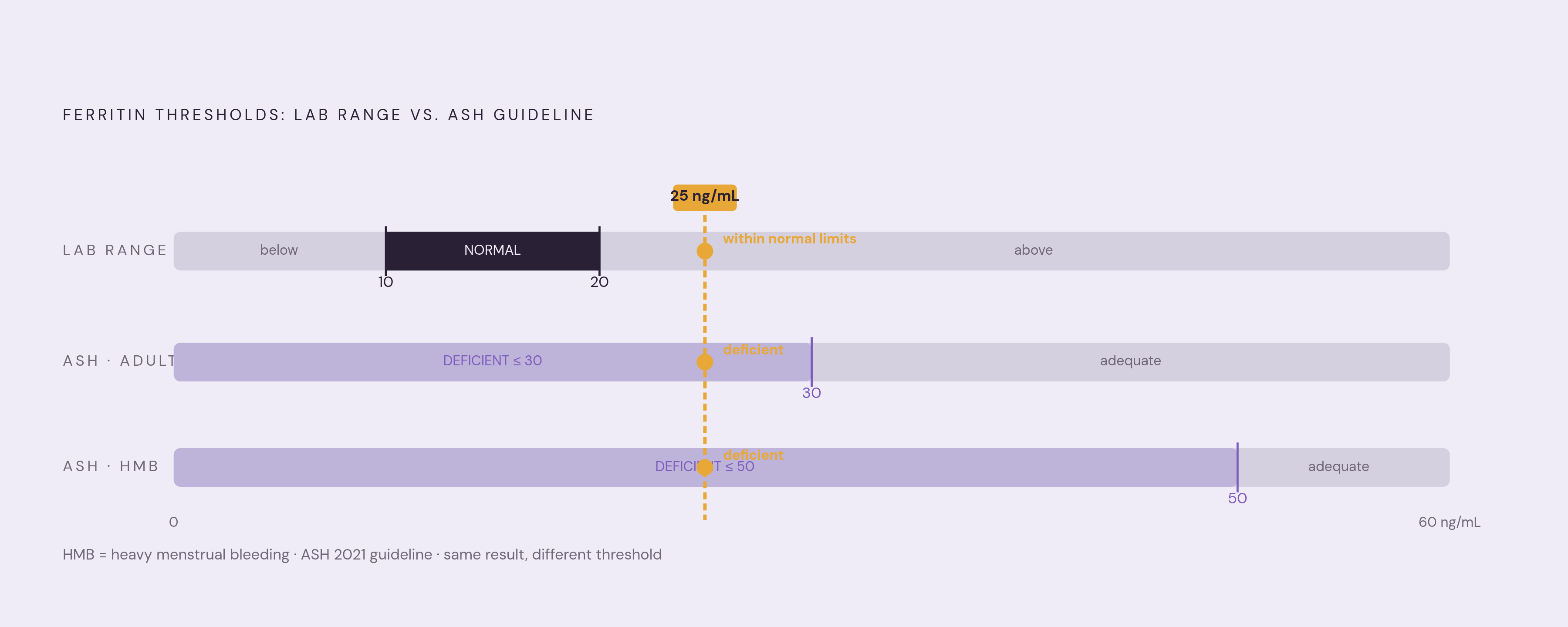
Getting the ferritin test ordered solves only part of the problem, because the interpretation of the result depends entirely on what threshold is used to judge it, and those thresholds have historically been set too low. Reference ranges vary from lab to lab, and some still list the lower boundary of "normal" at 10 to 20 ng/mL, a level far below what current research supports as adequate for normal energy production and hormonal function. A woman whose ferritin clears that bar can walk away believing her iron status is fine, even when it functionally is not.
The American Society of Hematology has moved to correct this. Its new guidelines, the first to standardize the diagnosis of iron deficiency, recommend revised ferritin thresholds that are substantially higher than many labs still use. Under these guidelines, people who would previously have been told they were iron-sufficient are now classified as deficient. For otherwise healthy adults, a ferritin level at or below 30 ng/mL now qualifies as iron deficiency. For women with heavy menstrual bleeding specifically, the threshold is higher still: 50 ng/mL or below.
The practical effect of this mismatch is easiest to see in a concrete case. A ferritin result of 25 ng/mL clears the floor of many lab reference ranges, which may still list 10 to 20 ng/mL as the lower limit of normal. That same result falls below both the general threshold and the heavy-period threshold recommended under the new ASH guidelines. A woman with that number could be told by the lab's own reference range that her iron is within normal limits, while a clinician applying the updated clinical guidance would consider her clearly deficient. The number on the page does not change. What changes is which ruler gets used to measure it, and that choice determines whether she is told she is fine or told she needs treatment.
One caveat deserves attention without derailing the larger point. Ferritin is an acute-phase reactant, so inflammation or infection can artificially raise it, masking a deficiency that would otherwise be visible. A high ferritin reading in the presence of inflammation does not necessarily mean iron stores are adequate. This is why ferritin is best interpreted alongside transferrin saturation, which provides additional context and helps account for inflammation's distorting effect. The caveat does not undercut ferritin's value. It sharpens the case for interpreting ferritin with the right clinical context.
What a complete workup looks like
Ferritin shows how much iron the body has in reserve, but iron is only one piece of what is happening physiologically during perimenopause, so a complete workup tests both domains. A comprehensive hormone panel covers ground that ferritin cannot touch. Estradiol and progesterone reflect the hormonal shifts behind anovulatory cycles and heavy bleeding. FSH is particularly useful not as a single data point but as a trend: testing it serially, for instance on day 3 of the cycle and repeated annually, reveals a rising pattern that one isolated reading cannot show. FSH begins climbing roughly six years before a woman's last menstrual period, long before most other signs of the transition become obvious. LH, DHEA-S, and AMH round out the picture, offering additional context on ovarian reserve and metabolic function.
Thyroid markers belong in this panel as well, and skipping them is a meaningful omission. TSH, and where indicated free T3 and T4, matter because thyroid dysfunction produces fatigue, mood changes, menstrual irregularity, and cognitive symptoms that closely resemble both perimenopause and iron deficiency. All three conditions, hormonal transition, iron depletion, and thyroid dysfunction, can be present in the same woman at the same time, each contributing to the same cluster of complaints.
Ferritin, and ideally transferrin saturation alongside it, needs to be requested explicitly rather than assumed to ride along with a hormone or metabolic panel. Hormone testing alone will not detect an iron problem, and a CBC alone will not detect a thyroid problem. Each marker has to be asked for on its own terms. Timing matters too: day 3 to 5 of the menstrual cycle is the conventional window for testing estradiol, LH, and FSH, because these markers are more stable and closer to baseline during the early follicular phase. Progesterone, by contrast, is tested around day 21, in the mid-luteal phase, to assess whether ovulation occurred that cycle.
Because hormone levels during perimenopause fluctuate erratically, a single reading tells less than a pattern does, and the same logic applies to ferritin. Tracking ferritin across successive cycles, rather than relying on one test in isolation, shows whether depletion is worsening, holding steady, or responding to treatment. A single lab result is a snapshot. A series of results, reviewed together over time, becomes a trajectory, and trajectories support genuinely personalized clinical decisions.
Why perimenopause symptoms mask contributing iron deficiency
The overlap between iron deficiency symptoms and perimenopause symptoms is near total, and that overlap creates a systematic error in how women's complaints get interpreted. Fatigue, brain fog, mood disruption, sleep difficulty, and poor exercise tolerance belong to both conditions. When a woman in her 40s brings these symptoms to a clinician, perimenopause is frequently the assumed explanation, and the workup often stops there without testing for anything else. The same error pattern shows up around thyroid dysfunction, which produces a nearly identical symptom cluster and also becomes more common during midlife. In both cases, treatment addresses only the hormonal piece, while a second, untreated condition, iron deficiency or thyroid dysfunction, continues to drive symptoms underneath it.
One might argue this attribution is not unreasonable. Iron deficiency may be worsening symptoms that are also, separately, hormonally driven, and how much each factor contributes matters less than the practical fact that leaving the iron deficiency unaddressed leaves a woman less well than she could be with proper treatment.
Iron deficiency in this population is common, underdiagnosed, and undertreated, and the gap between what current research supports and what standard practice still does is substantial. The ASH guidelines represent a genuine shift in how clinicians are meant to think about iron deficiency diagnosis, but clinical guidelines change practice slowly, often over years, as new thresholds work their way into lab defaults and physician habits. Individual women navigating fatigue and heavy bleeding right now are not in a position to wait for that lag to close on its own.
How to ask for the right workup and evaluate the results
Closing that gap starts with knowing what to ask for, since a woman who understands what ferritin measures and what the current thresholds actually indicate is far better equipped to request the right tests and to evaluate what comes back than one who accepts "your bloodwork is normal" as the end of the conversation. A serum ferritin test should be requested by name, since it is not automatically included in a standard CBC and will not appear in results unless it is specifically ordered. Transferrin saturation is worth requesting alongside it, particularly if inflammation or infection is a possibility, since ferritin can be artificially elevated under those conditions and transferrin saturation helps clarify what is really happening with iron stores. A hormone panel covering estradiol, progesterone, FSH, and LH rounds out the picture, and timing it to day 3 through 5 of the cycle gives the most interpretable baseline reading for estradiol, LH, and FSH specifically. Thyroid function, including TSH and, where indicated, free T4, should be checked as well, since thyroid dysfunction can produce or worsen the same fatigue, mood changes, and cognitive symptoms that get attributed to perimenopause or iron deficiency alone.
Once the ferritin result comes back, the number itself matters less than the threshold used to interpret it. A result at or below 30 ng/mL is consistent with iron deficiency under the current ASH guidelines, regardless of what the lab's own printed reference range happens to say. For a woman with heavy menstrual bleeding, that threshold moves higher still, to 50 ng/mL, reflecting the greater blood loss and higher iron demand specific to her situation. Asking whether a result was interpreted against the updated ASH threshold or against an older lab-specific range is a reasonable, informed question to raise directly with a clinician, and it is the kind of question that turns a passive lab report into an active, evidence-grounded conversation about what the number actually means.
Sources
- Iron deficiency in peri-menopausal women: Clinical considerations from an expert consensus - Indian J Obstet Gynecol Res
- Addressing the perimenopause: what’s blood got to do with it? - ScienceDirect
- Heavy menstrual bleeding, iron deficiency, and iron deficiency anemia: Framing the issue - Munro - 2023 - International Journal of Gynecology & Obstetrics - Wiley Online Library
- Iron Deficiency Begins Before Anemia
- Iron Deficiency and Iron Deficiency Anemia: A Comprehensive Overview of Established and Emerging Concepts
- Physiologically based serum ferritin thresholds for iron deficiency in US older adolescents and adults
- Iron Deficiency without Anemia: A Common Yet Under-Recognized Diagnosis in Young Women with Heavy Menstrual Bleeding - PubMed
- Iron Deficiency without Anemia: A Common Yet Under-Recognized Diagnosis in Young Women with Heavy Menstrual Bleeding