Hormone Panel Baseline for Women in Their Late Thirties
Understanding your baseline hormones now prevents misdiagnosis later.
A hormone panel in the late thirties is precisely timed, and the biology explains why. Most women are told that perimenopause is a problem for the mid-to-late forties, a decade still comfortably ahead of them, something to think about later. The Menopause Society defines the transition not by birthday but by a specific physiological marker: menstrual cycles that begin varying by seven or more days from a woman's usual pattern. That threshold is tied to cycle variation, not age. A 2025 study in Archives of Gynecology and Obstetrics cites the North American Menopause Society's definition of the perimenopausal period as the years leading up to, and the single year following, the final menstrual period, typically falling between ages 40 and 60, while also noting that ovarian function decline and age-related metabolic shifts occur throughout that transition window rather than at its edges. Genetics shape when a given woman enters that window, but so do smoking history, autoimmune conditions, certain cancer treatments, and socioeconomic factors; the onset is unpredictable at the individual level even where it is well documented at the population level.
How perimenopause begins hormonally, and why the sequence matters for testing
The hormonal shift does not begin with estrogen, and that single fact reorganizes how testing should work. The earliest signal is a decline in progesterone, as ovulatory cycles become less consistent and luteal-phase progesterone production starts to drop before any other marker moves. Progesterone metabolizes into allopregnanolone, a GABA-A positive allosteric modulator, so its decline reduces inhibitory neurosteroidal tone in the brain. That mechanism is what underlies the anxiety, sleep fragmentation, and emotional reactivity so many women notice first, often years before a menstrual cycle visibly changes. FSH rises progressively across adulthood, with a more distinct increase often appearing as early as the early forties even in women whose other hormone readings look normal. FSH elevation can arrive before estrogen shows any visible change. A normal estradiol reading, taken alone, does not rule out early perimenopausal change if FSH is already climbing, and single-marker testing misses this constantly because it only ever looks at one piece of a moving picture. The defining feature of this transition is erratic fluctuation rather than steady decline: estradiol can read as perfectly normal on a given day even as the underlying hormonal pattern has already begun to shift. Waiting for an obvious change in estrogen means waiting for a signal that arrives after the useful window has already started closing.
What a single test during symptomatic perimenopause cannot tell you
A hormone test drawn after symptoms appear measures a moving target against a population reference range, and that is a different thing entirely from measuring it against a woman's own established normal. Population reference ranges are wide by design. A woman can lose a substantial share of her progesterone, or show a meaningfully elevated FSH, and still land inside the "normal" band if no one ever established what her own normal looked like beforehand. Because perimenopausal hormone levels fluctuate erratically rather than declining in a straight line, a single test taken mid-transition can catch a hormone on a temporary upswing and look reassuring even while the broader trajectory is downward. AMH and FSH read together with estradiol do improve diagnostic support, but only when the direction of change is known. Without a baseline, a low-normal AMH result is close to uninterpretable: there is no way to tell whether that number was always low or whether it has fallen from something higher. Some clinicians argue that a result from the late thirties will not look meaningfully different from a result in the forties, so establishing a baseline early adds little value. That objection misunderstands what the baseline is for: its value sits in detecting an individual woman's deviation from her own normal, not in demonstrating a population-level difference between one decade and the next. A related concern holds that AMH gets treated as a definitive biological clock when it isn't one. AMH works as a useful longitudinal marker rather than a precise predictive tool, and its accuracy improves considerably when it gets tracked over time alongside other markers and alongside symptoms, rather than read once and treated as a verdict.
Why each marker belongs in the panel
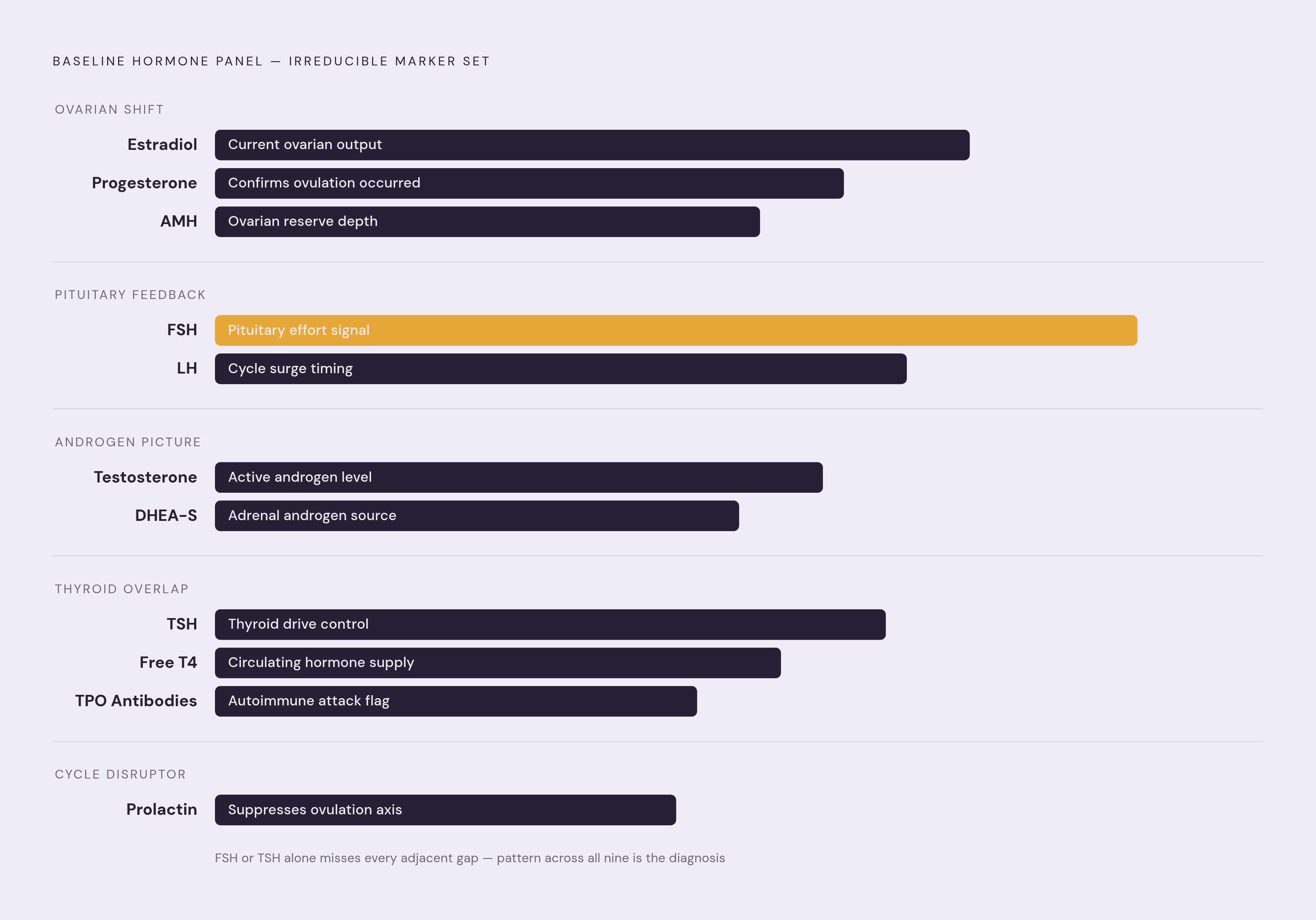
A meaningful baseline panel covers the full hormonal picture: estradiol, progesterone, FSH, LH, testosterone, DHEA-S, AMH, thyroid markers, and prolactin. Each of these answers a distinct question, and leaving any one of them out opens a diagnostic gap that an overlapping condition will exploit later. Estradiol is the primary estrogen marker, and while it is insufficient on its own, it becomes essential once read in combination with FSH. Progesterone is the earliest-shifting hormone in the entire transition, and its decline, the first signal to appear, gets missed whenever testing stops at estradiol and FSH. FSH itself rises progressively and functions as a stronger predictor of bone loss than estrogen alone across longitudinal studies, so a rising FSH reading is a clinically important signal in its own right rather than something to dismiss because estradiol still looks fine. LH works alongside FSH to characterize the pituitary-ovarian feedback loop, and that pairing helps distinguish perimenopause from other causes of cycle irregularity that produce similar symptoms. Testosterone and DHEA-S matter for the energy, mood, and libido changes many women notice early, and they also help separate PCOS-related androgen excess from the androgen decline that accompanies perimenopause, two conditions that can otherwise look similar on paper. AMH stands as the most stable marker to track over the long run: following it across multiple tests improves prediction of the broader menopause trajectory, with accuracy rising further when it is considered alongside the other markers and a woman's actual symptoms. Thyroid markers, specifically TSH, Free T4, and TPO antibodies, matter because hypothyroidism and early autoimmune thyroiditis produce fatigue, cognitive fog, and cycle changes that are clinically indistinguishable from early perimenopause on symptoms alone. TSH by itself misses subclinical hypothyroidism and autoimmune thyroiditis, and TPO antibodies are what catch the autoimmune overlap that a TSH-only order would never find. Prolactin rounds out the panel as a straightforward rule-out: hyperprolactinemia disrupts cycles and a baseline prolactin reading handles that possibility cleanly. An order for FSH alone, or TSH alone, will miss perimenopause, miss PCOS, and miss thyroid overlap, because the real diagnostic value sits in the pattern across all these markers together, not in any single result read in isolation.
Which conditions share symptoms with early perimenopause, and how the panel catches them
Several common conditions produce symptoms that look, from the outside, identical to early perimenopause, and a comprehensive panel is the mechanism that actually tells them apart. That function is what makes the panel a diagnostic tool rather than a wellness add-on. Hypothyroidism sits at the top of that list: the fatigue, brain fog, weight changes, and cycle irregularity it produces overlap almost exactly with early perimenopausal symptoms, and the panel catches it specifically through TSH, Free T4, and TPO antibodies. Hyperprolactinemia disrupts cycles and causes mood and cognitive changes of its own, and a prolactin reading in the panel rules it out without ambiguity. PCOS brings irregular cycles, androgen-related symptoms, and metabolic effects that can mimic perimenopause closely, and testosterone, DHEA-S, the LH/FSH ratio, and AMH read together are what separate the two conditions. Premature ovarian insufficiency represents an earlier-onset form of ovarian decline that calls for a different clinical response entirely, and FSH, estradiol, and AMH together support identifying it.
The most urgent overlap, though, involves anxiety and depression. Research on the perimenopausal anxiety burden documents a direct overlap between hormonal disruption and psychiatric symptoms, and women are frequently treated for the psychiatric consequence while the hormonal driver behind it goes unaddressed. Progesterone's role as the precursor to allopregnanolone connects these two pictures directly. A standard psychiatric workup does not look at hormones, so it has no way to reveal that declining progesterone is a plausible mechanism behind new anxiety or fragmented sleep. The 2025 quality-of-life study found anxiety symptoms present in 58.9% of perimenopausal participants, with depressive symptoms similarly prevalent, and found that these, alongside sleep disturbance, ranked among the strongest independent predictors of impaired quality of life in the study population. One might argue that treating the anxiety directly is still reasonable regardless of its cause. But if progesterone decline is the driver and nobody has measured it, the treatment addresses the symptom while the mechanism producing it continues unaddressed, and that is precisely the gap a comprehensive panel is built to close.
What tracking multiple tests over time can reveal
A single hormone test answers one question: where is this woman's body today. Repeated tests measured against an established baseline answer a different and more useful question: what direction is she moving in, and how quickly. The direction carries more clinical weight than any single snapshot ever can. AMH is the marker best suited to this kind of longitudinal tracking, since it declines gradually and consistently rather than fluctuating sharply, and following it over time improves prediction of the broader menopause transition, with accuracy increasing further when it is read alongside other markers and symptoms. FSH tracked over multiple tests is a stronger predictor of bone loss than estrogen alone, a finding that matters because bone mass peaks in the third decade of life and accelerated bone loss tends to begin roughly one year before menopause itself. That timing means the window for intervention sits before the loss becomes something a woman can feel or a scan can easily catch. Estradiol, by contrast, fluctuates too erratically for any single reading to mean much on its own. A series of readings over time is what reveals whether the broader trajectory is holding steady, climbing (as happens in anovulatory cycles), or genuinely declining.
This tracking also connects to a larger clinical idea known as the critical window hypothesis, which holds that therapeutic response to hormonal intervention is strongest when treatment begins near the actual onset of the transition, before neural and vascular changes have had time to accumulate. A February 2026 study in Frontiers in Medicine identifies perimenopause as a critical window for integrated vascular and hormonal interventions aimed at preserving cognitive health, reframing the conversation from reactive symptom management toward proactive disease prevention. None of that tracking means anything, though, without a starting point. A hormone panel drawn in the forties has no personal reference point to measure against, and the direction of change for that individual woman simply cannot be known. The baseline drawn in the late thirties is what gives every subsequent test its meaning.
Why women in their late thirties rarely get this panel without asking for it
The healthcare system is not built to offer a comprehensive hormone panel to a woman in her late thirties who still has regular cycles. That gap means the baseline will not happen on its own. It requires a woman to request it specifically, and to know what she is asking for. Perimenopause and its earliest hormonal changes are often thin material in medical training curricula, so clinicians themselves are rarely taught to recognize it early, and that gap compounds directly with the timing issue described earlier in this piece. Women in their thirties who bring up early symptoms are frequently told they are too young for perimenopause to be relevant, a response that is itself a direct consequence of the outdated age framing this article opened by challenging. A woman who shows up to an appointment without naming a specific panel is likely to walk out with a single-marker order, FSH alone or TSH alone, and as the panel section above lays out, that kind of order misses the diagnostic picture almost by design.
How to read the results
The 2025 quality-of-life research is clear that perimenopausal symptoms meaningfully impair quality of life across sleep, mood, and physical domains, yet the structural conditions needed for early identification simply are not in place for younger women. Closing that gap falls, in practice, to the individual woman walking into the appointment. A detailed cycle and symptom log kept before an appointment, tracking cycle length, any missed periods, and how long changes have lasted, gives a clinician something concrete to work from instead of a vague impression. Requesting a named, comprehensive panel rather than accepting a single-marker screen is what keeps the appointment from defaulting to an FSH-only or TSH-only order. And understanding, going in, that a normal estradiol reading does not rule out early perimenopausal change prevents a woman from being reassured by a number that was never going to catch the real shift.
A validated self-assessment or tracking tool changes what a woman is able to bring into that clinical encounter. It shifts the conversation from "I feel different" to a documented pattern laid out across weeks or months, built from the same logic that runs through this entire piece: a single reading shows a position, but a baseline, followed by tracking over time, shows a direction. That distinction, between a snapshot and a trajectory, is what turns a hormone panel from a one-time data point into the foundation for understanding a transition that, for a meaningful number of women, has already begun well before anyone told them to expect it.
Sources
- Investigation of the quality of life and influencing factors among perimenopausal women
- Global, regional, and national burden of anxiety disorders during the perimenopause (1990–2021) and projections to 2035
- Hormonal Changes in the Menopause Transition
- Testosterone and pre-androgens by age and menopausal stage at midlife: findings from a cross-sectional study
- A threshold of β-CTX (0.3 ng/mL) with low estradiol identifies high-risk perimenopausal women for bone loss: a cross-sectional study
- Antimüllerian Hormone as a Tool to Predict the Age at Menopause
- Longitudinal Biomarker Assessment in Reproductive Aging: Discover Risks by Interpreting Multi-Hormone Patterns Over Time - Personalized Lifestyle Medicine Institute