HSA and FSA Eligibility for At-Home Hormone Testing
You can use pretax HSA and FSA dollars to pay for at-home hormone testing.

At-home hormone testing qualifies as a legitimate HSA and FSA expense because the IRS standard rests on medical purpose, not on where a sample is drawn or who initiated the order. The rule is simpler than most people assume, yet widespread confusion about eligibility leaves millions of pre-tax dollars unspent.
Why at-home hormone testing is a legitimate medical expense under IRS rules
The governing standard for both HSA and FSA eligibility is a provision of the federal tax code, which defines a qualified medical expense as a cost incurred for the diagnosis, cure, mitigation, treatment, or prevention of disease. Nothing in that definition mentions a physician's office, a hospital laboratory, or a prescription. The question the statute asks is what the service does, not where it happens or who ordered it.
Publication 502 reinforces this reading. The IRS document explicitly includes annual physical examinations and diagnostic tests as medical expenses, and it states plainly that the patient does not have to be ill at the time of the examination. The relevance, however, is structural: the IRS already recognizes that diagnostic testing carries medical purpose independent of acute illness.
You might not see it that way at first, but these panels are diagnostic laboratory services. A licensed physician authorizes the order, and a federally certified laboratory processes the sample. The patient initiates the purchase, but the clinical chain remains intact. The qualifying factor is what the test is, not who happened to click the order button.
A common and costly misconception holds that an expense is only eligible if insurance agrees to cover it. Eligibility is determined by IRS rules, not by an insurance company. A service that a health plan denies can still be a legitimate qualified medical expense for HSA or FSA purposes. There is likewise no network restriction: HSA and FSA funds work at any provider for qualifying medical expenses. A consumer-ordered hormone panel costs you less in take-home pay when you pay with pre-tax dollars.
Has the reader been underestimating eligibility? If you order it for symptom evaluation, monitoring, or diagnostic clarity, it fits squarely under section 213(d). The next section addresses where the line can, in practice, be pushed.
Where the eligibility line can be challenged: the diagnostic-purpose standard in practice
The only meaningful eligibility risk for hormone testing is whether the test reads as a diagnostic medical service or as a general wellness product. Metabolic panels, lipid profiles, A1C, thyroid markers, hormone levels, and vitamin assessments all sit comfortably inside the qualified-expense definition. FSH, estradiol, progesterone, and AMH panels do not belong in that category.
Hormone panels ordered because a woman is experiencing symptoms are diagnosis and monitoring by definition. Irregular cycles, vasomotor symptoms, mood changes, and sleep disturbance all pose a clinical question, and blood work can help answer it. This is not general wellness spending. It is the same kind of diagnostic activity that occurs in any medical office, relocated to a mail-order blood draw.
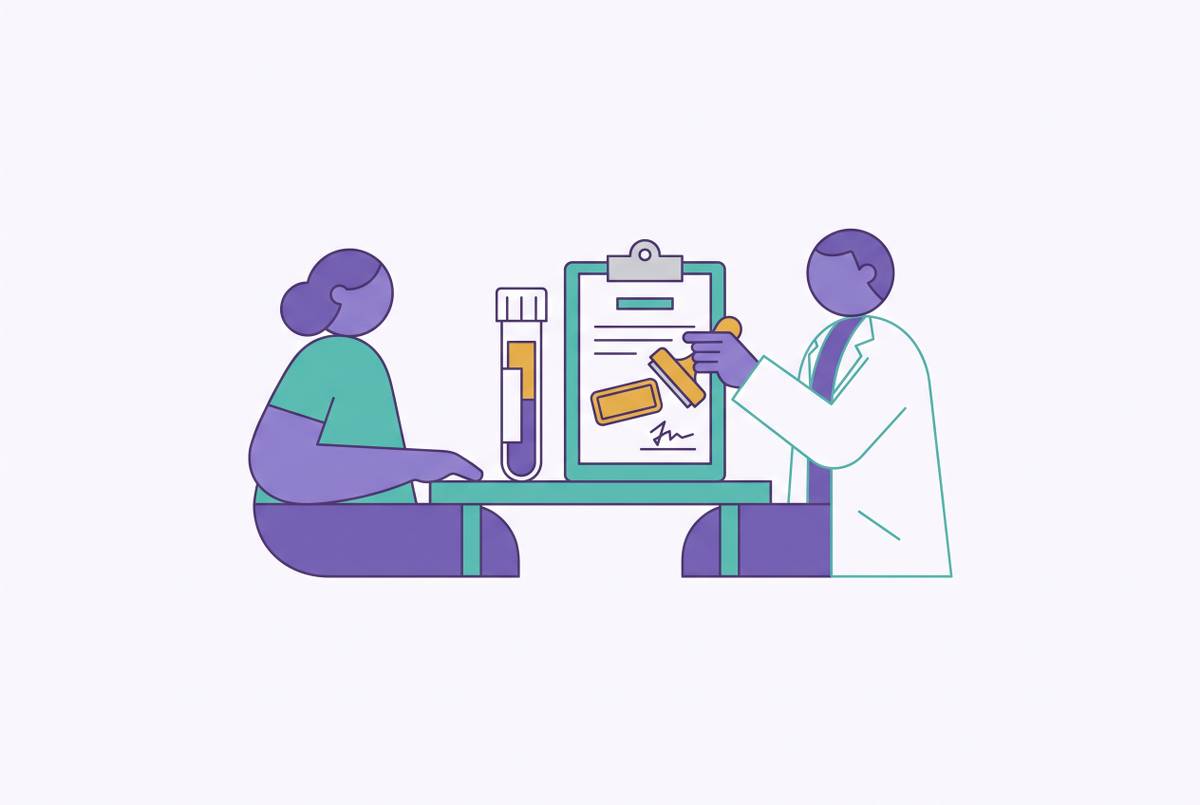
Where a plan administrator does ask for more documentation, the issue is rarely the test itself. It is the absence of an itemized receipt that names the specific tests performed. The administrator needs to see what was measured and why it qualifies. An itemized receipt resolves most questions without further inquiry. If an item appears dual-purpose, some administrators may ask for a Letter of Medical Necessity. The letter is a signed statement from a licensed healthcare provider that a product or service is medically necessary to diagnose, treat, or monitor a condition. Testing services with built-in clinician review make obtaining one straightforward.
Who decides brings its own nuance. The IRS sets the definition, but an employer's FSA plan can be stricter than the IRS floor. An HSA holder carries the determination and keeps the receipt. No pre-approval is needed for HSA spending. A1c and vitamin D are not included at that price, and the six named tests cost considerably more when ordered individually.
Why perimenopause testing has a clear clinical rationale — and why that rationale matters for your claim
Perimenopausal hormone testing is not elective curiosity. It responds to a transition marked by hormonal fluctuation that a single clinical encounter cannot capture. The transition typically spans several years before menstruation ceases and manifests as vasomotor symptoms, mood changes, sleep disturbances, and cognitive alterations. Each of those symptoms has clinical diagnostic significance.
During perimenopause, estrogen and progesterone levels do not decline steadily. They fluctuate unpredictably, which is why symptoms can come and go or change intensity from month to month. The most potent and biologically active estrogen, 17β-estradiol, is produced primarily by the ovaries, and low levels of it drive hot flashes, night sweats, and sleep disturbance. Decreased ovarian production of inhibin B causes increases in serum FSH and estradiol at the beginning of the cycle.
No single blood test can confirm perimenopause because hormone levels change daily and even hourly. A leading professional society for obstetricians and gynecologists has noted that FSH levels can fluctuate widely from day to day, making a single reading unreliable as a diagnostic tool. Because of this variability, repeated testing has a recognized clinical rationale. AMH offers a complementary view: it reflects ovarian reserve and does not fluctuate as dramatically across the cycle, making it a more stable marker alongside FSH and estradiol.
The clinical rationale for each test ordered is well-established and documented. That documentation is the substance of the medical-purpose standard. The stakes, measured another way: women in perimenopause are 40% more likely to experience depression than women at any other stage of life. Hormone testing is not trivia. It is diagnostic work on a transition with real physiological and psychological consequences.
How FSA and HSA accounts differ in ways that directly affect how and when you use them for testing
The FSA's use-it-or-lose-it rule and the HSA's rollover flexibility call for different purchasing strategies. If you do not understand the difference, you leave pre-tax money unused or mistimed. An HSA requires enrollment in a qualifying high-deductible health plan. FSA money is use-it-or-lose-it, with some plans allowing limited carryover.
The tax structures differ as well. HSAs offer a triple tax advantage: pre-tax contributions, tax-free growth, and tax-free withdrawals for eligible expenses. FSAs offer pre-tax contributions and tax-free withdrawals but no investment growth. Both accounts discount eligible testing costs depending on the account holder's tax bracket. Pre-tax HSA and FSA contributions provide an effective discount of 20 to 30 percent on lab tests, depending on where the holder falls in the bracket structure. Contribution limits apply to both, set annually by the IRS, and HSA limits differ between self-only and family coverage while the medical FSA has its own cap.
For FSA holders, the deadline is the action-driving insight. Unused funds approaching year-end make hormone testing, whether initial lab work or follow-up panels, a sound use of money that would otherwise be forfeited. For HSA holders, the calculus inverts. Because funds roll over, you can build a longitudinal testing record in an HSA over multiple years without deadline pressure. That is a natural fit for repeated hormone tracking during a transition that itself unfolds over years. FSA rules on family coverage vary by plan.
The implication for readers: account type determines timing strategy. FSA holders optimize for the deadline. HSA holders optimize for the pattern.
The two payment paths: paying at checkout versus submitting for reimbursement
Either path produces the same pre-tax benefit. Labcorp OnDemand, for example, accepts HSA and FSA cards for more than 100 eligible tests, including hormone and ovulation panels, with no doctor's appointment needed. Where a service does not accept the card at checkout, the process is simple: pay with any payment method, retain the itemized receipt, and submit it to the plan administrator for reimbursement. Identical tax benefit, one additional step. Some services bring in a third-party reimbursement partner that files claims automatically after purchase. The patient pays at the time of service and submits documentation afterward.
The itemized receipt is the essential document in both paths. It must include the date of service, a description of the services or tests performed, the provider name, the clinic or laboratory tax ID number, and the total charges. For HSA accounts, no pre-approval is needed. The holder retains the receipt and carries the determination. For FSA accounts, the plan administrator reviews the substantiation. Neither path should be burdensome when the receipt is complete. One economic point worth noting: direct-pay laboratory services offer discounts of 50 to 80 percent compared to hospital billing rates.
When a Letter of Medical Necessity strengthens your claim and how to get one
A Letter of Medical Necessity is not a sign that a claim is borderline. It is a standard documentation tool that administrators use for items without a universal eligibility code. The letter is a signed statement from a licensed healthcare provider affirming that a product or service is medically necessary to diagnose, treat, or monitor a health condition. Some HSA and FSA administrators require one before they will consider reimbursement.
For standard lab panels, an LMN request is relatively uncommon. The letter becomes relevant when the item is newer, unusual, or appears dual-purpose to the administrator. A hormone testing service that includes clinician review as part of the product can supply LMN documentation more easily when asked. The physician who reviews results and can speak to the diagnostic intent of the panel is the same clinician who can substantiate medical necessity.
That distinction is material. A testing service with integrated clinical interpretation already has that justification built into its workflow. For a composite panel, the market price is visible: RequestATest offers a comprehensive women's hormone panel for $279. The service includes the clinical infrastructure for both interpretation and documentation.
Why repeated hormone testing over time is both clinically sound and a smart use of HSA funds
No single hormone measurement can characterize a transition as variable as perimenopause. Repeated testing over time is not overuse of benefits. It is the clinically appropriate approach. The HSA's rollover structure makes it the natural vehicle for funding that repetition. Hormone levels fluctuate unpredictably during this transition. FSH can register in the menopausal range one month and not the next. Progesterone peaks in the mid-luteal phase and is uninformative at other points in the cycle. A single test captures a moment, not a trajectory.
Providers often recommend testing FSH multiple times over several months so a pattern can emerge. The same logic applies to estradiol and progesterone tracking across the transition. Days 19 through 21 capture the mid-luteal peak for progesterone, approximately seven days after ovulation. AMH does not fluctuate dramatically across the cycle and can be tested at any point, making it a useful complement to repeated FSH and estradiol tracking.
One important caveat follows. Hormonal contraceptives suppress natural hormone production and significantly alter FSH, estradiol, and progesterone levels, making results unreliable for assessing perimenopause. That matters for many women in their forties who are still using contraception. Perimenopause is frequently misattributed to thyroid dysfunction, depression, anxiety, or PCOS. Longitudinal hormone data lets the full picture emerge and distinguishes one condition from another over time.
The account structure aligns with the clinical pattern. Estimating testing frequency and cost during the enrollment period prevents both underfunding and forfeiture. The clinical need is longitudinal, and the funding vehicle can match it.
How to use your benefits confidently: a practical checklist before you buy
You need no special approval in advance to use HSA or FSA funds for hormone testing. You need to know the account type, confirm the service's payment process, and keep the right documentation. The following checklist operationalizes each step.
First, know your account type. An HSA requires a qualifying high-deductible health plan. An FSA is employer-offered. Confirm which one applies, check the current balance, and for an FSA note the use-by deadline. Second, confirm the plan's eligible-expense list. Employer FSA plans can be stricter than the IRS floor, so a two-minute check against the plan list or a call to the administrator is the safest step when the dollar amount matters. Third, choose a payment path. If the testing service accepts an HSA or FSA debit card at checkout, use it directly. If not, pay by any method, retain the itemized receipt, and submit for reimbursement. Same benefit, one extra step.
Fourth, request an itemized receipt. It must include the date of service, a description of each test, the provider or service name, the tax ID number, and the total charges. That receipt is the primary substantiation document. For HSA accounts especially, you bear responsibility for substantiation if the IRS later reviews the withdrawal.
Is $299 for a standard women's hormone panel from HealthLabs a legitimate use? Yes, and the receipt that itemizes it is the instrument that proves it. If you understand the IRS framework, prepare your documentation, and choose testing services with clinical oversight built in, you can access this benefit without friction. They can also build the kind of longitudinal hormone record that a single clinic visit cannot produce. The pre-tax dollars are already there. The clinical question is already being asked. The two meet, with surprising regularity, in the same receipt.